How Much Does a Mini Excavator Cost? The Whole Number, Not the Sticker
The price in the listing is the part everybody researches and the smallest part of what you will actually spend in year one. Here is the rest of the list, in the order it lands on you.
01The Short Version
Take the machine price. Add delivery, a trailer if you do not have one, two or three attachments, and a repair reserve. That is your real year-one number, and on a cheap import it can be close to double the sticker.
None of that makes it a bad buy. It makes it a different buy than the one in your head, and people get into trouble by spending their entire budget on the machine and then discovering they cannot move it or dig with it properly.
This page is the checklist. Where another page on this site owns the detail, we point at it rather than repeating it.
02What the Machines Themselves Cost
Three different markets, and people compare across them without realising.
New imported machines are the reason this site exists. At the time of writing, the one-ton class on Amazon clusters in the region of five thousand dollars, give or take a few hundred, with the 1.2 to 1.4 ton machines sitting above that. Prices shift and several listings have configurable attachment options that change the checkout figure, so treat that as a shape rather than a quote and check the current verified listings and what each one actually includes before you budget.
New name-brand machines — Kubota, Takeuchi, Bobcat, Yanmar — are a different market entirely, several times that, and are not really the alternative most readers here are weighing.
Used name-brand machines are the interesting one, because the bottom of that market overlaps the top of the new-import market. That is the comparison that actually matters and it deserves its own thinking: used name-brand against new no-name at the same money.
One honest note on the cheap end. Sub-one-ton machines are frequently more expensive than a one-ton, not less, because they are a specialist product with a smaller market. If you are shopping on price, the one to 1.2 ton class is usually where the value sits — which is covered properly in the smallest-machine guide.
03Getting It To You
Sometimes included, sometimes not, and occasionally the thing that blows the budget.
Most Amazon listings for these machines include freight to a commercial address or to the kerb. What that frequently does not include is a truck that can get down your driveway, a liftgate, or anybody to help you get a two-thousand-pound crate off a trailer.
Ask three questions before you buy: does the price include delivery to a residential address, what kind of truck shows up, and who unloads it. The answers change what you need standing by on the day. What actually happens on delivery day walks through it, and it is worth reading before rather than after.
04The Trailer Nobody Budgets For
This is the big one people miss, and it is frequently a meaningful fraction of what the machine cost.
If you already own a tandem-axle equipment trailer rated well above your machine plus attachments plus fuel, you are fine. A lot of people own a single-axle utility trailer that is already near its rating with a mower on it, which is not the same thing.
Then add chains and binders, and ramps if the trailer does not have a beavertail. None of that is optional if you intend to move the machine, and the physics does not care that it was not in your spreadsheet. What trailer, what ramps and what the tie-down rules actually require lays it out.
There is a real alternative worth naming: do not move it. Plenty of owners keep the machine on one property and hire a hauler the two or three times a year it has to go somewhere. A few hundred dollars a trip against several thousand for a trailer you use rarely is arithmetic worth doing honestly. And if you have not bought the machine yet, note that what you can legally tow is one of the three constraints that should decide the size you buy.
05The Attachment Tax
The machine comes with a bucket. Everything that makes it versatile is extra.
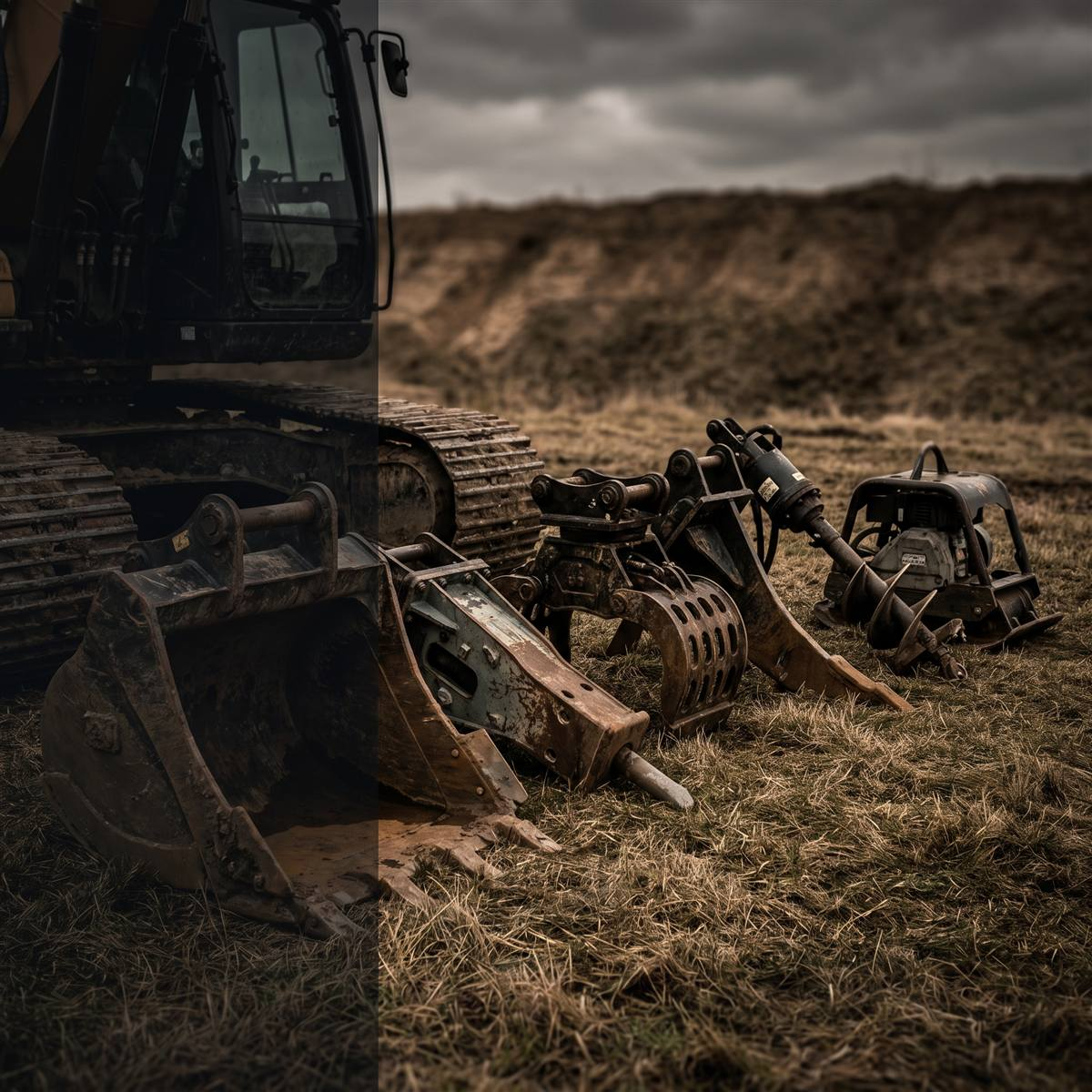
Most people end up wanting three things fairly quickly: a narrower or wider bucket than the one it came with, a thumb, and one specialist tool — an auger, a breaker or a grapple depending on the property. Each of those is a real purchase, and the specialist ones are not cheap.
Two traps here. The first is buying attachments before you know what fits: pin sizes and coupler patterns vary, and working out whether a given attachment physically fits your machine comes before working out whether you want it. The second is hydraulic attachments that your machine cannot actually drive — flow and pressure have to match or the tool runs badly or not at all.
The honest planning advice: buy the machine with a bucket, work with it for a season, and let the jobs tell you which attachments you actually need. Almost everybody who buys a full set up front has one they have never used.
06What It Costs To Run
Lower than people fear on fuel, higher than people expect on the undercarriage.
The recurring costs are fuel, engine oil and filters, grease, hydraulic oil and filters, and eventually tracks. For a machine doing fifty or sixty hours a year, the consumables are modest — this is not a vehicle, and it is not running every day.
The one that catches people is the undercarriage, because tracks are a four-figure item on a machine that might have cost five figures, and they wear in hours rather than years. The full running cost breakdown goes through each line properly, and what a set of tracks costs and what makes them last is the number to have in mind.
You cannot manage any of this without knowing your hours. If the machine has no working hour meter, fit one — it is the cheapest item on this entire page and it is what turns guesses into a cost per hour.
Vibration-triggered hour meter for small engines →
07The Repair Reserve Nobody Keeps
Set money aside before you need it, especially on an off-brand machine.
Things break. On a cheap import the common early ones are small and cheap — hoses, fittings, bolts working loose, a switch. The ones that hurt are the big rotating components, and a final drive or a swing motor can be a serious fraction of the machine’s value.
We are not going to put a percentage on it, because the honest answer depends entirely on which machine, how hard you work it and whether parts are available. What we will say is that buying a machine with literally nothing left over is how people end up with a broken machine they cannot afford to fix, which is a worse outcome than having bought a smaller one.
The thing that most changes this number is not the brand on the side. It is whether anybody stocks parts for it. Ask the parts question before you buy, not after — a lot of what breaks is generic and cheap, and the rest is what strands a machine.
08The Ones People Forget Entirely
Individually small. Together they are a line on the budget.
Somewhere to keep it. A machine stored outside costs you in rust, seals and starting problems instead of in dollars up front, and a roof is the single best thing you can do for its lifespan. If you do not have a building, that is either a cost or a consequence.
Insurance. Often not covered by a standard homeowner policy at this value, and worth asking about rather than assuming. Insurance, registration and the rest of the legal odds and ends are covered separately.
Fuel cans, funnels, a grease gun, a drain pan, basic tools. Small money, but you need it on day one, not day thirty.
Your own time. Not a dollar figure, but the real one. A job that a contractor does in a day takes a first-time owner a weekend. That is fine when the point is to own the machine. It is less fine if you bought it purely to save money on one job.
Tax treatment, if any of this is business use. Equipment used in a business is depreciated rather than simply expensed, and the rules are their own subject — the IRS publication covering how property gets depreciated is the primary source, and an accountant is a better guide than we are.
09What Renting Costs Instead
We will not print rental rates. They are regional and they would be wrong by the time you read this.
What we will give you is the method, which takes one phone call. Ring two local yards. Ask the day rate, the week rate, and what delivery and pickup cost each way. Then ask yourself honestly how many days of work you have, this year and next.
The arithmetic usually breaks one of two ways. A handful of days spread over two years and renting wins comfortably, especially once you count the trailer you did not buy and the storage you did not need. Twenty or thirty days a year, or jobs that come up unpredictably and need doing that afternoon, and owning wins — and the convenience of a machine sitting there is worth real money that never shows on a spreadsheet.
The full buy-versus-rent comparison works through it properly, including the cases where the answer is neither and you should just hire somebody.
10What You Get Back
The cost of owning is not what you paid. It is what you paid minus what you sell it for.
This is the part that makes the whole exercise look better than it first appears. A machine you keep clean, service, store inside and sell with records is worth real money second-hand. The depreciation over a few years of light private use is frequently a lot less painful than people assume, because you are not putting commercial hours on it.
Off-brand machines do not hold value the way a name brand does, and that gap is a genuine cost of buying cheap — what an off-brand machine is actually worth when you come to sell is worth reading before you buy, not after. The things that most protect resale are the same things that protect the machine: hours you can prove, condition you can show, and a roof.
11What I Would Do
Write the whole list down before you spend anything, and leave the last twenty percent of the budget unspent.
Machine, delivery, trailer or hauling, two attachments, a repair reserve, and the small stuff. Put a real number against each. If the total is more than you wanted, the right lever is almost always a smaller or cheaper machine, not skipping the trailer or the reserve — those two are what turn a good buy into a bad one.
And run the honest test from the lead magnet before you commit: if this machine does exactly what the listing says, for as long as you would reasonably expect, at this total number — would you still buy it? If the answer only works when nothing goes wrong, it does not work.
Then decide what size the jobs actually call for, with the three constraints that set your size, and go and look at whether an excavator is even the right machine for your list if you have not already.