Chinese Mini Excavator Parts You Can Easily Find on Amazon For These Machines
You’ve put real hours on it building the place — and now something needs replacing. Bought your mini excavator on Amazon and need a part? Here’s how to identify your machine, find the right component on Amazon, and avoid ordering something that looks like it fits but doesn’t.
01Quick Answer: How Do You Find Chinese Mini Excavator Parts on Amazon?
Finding parts is not always as simple as searching the brand name. Start with your exact machine, then verify the part itself.
The good news is bigger than most first-time owners expect. Most of what actually wears out on these machines — filters, tracks, hoses, bucket teeth — is a standard component rather than a proprietary one. That is why rubber tracks, sprockets and idlers and the hydraulic pumps, valves and hoses behind every motion are usually findable even when the brand itself has gone quiet, and it is than a mysterious “Chinese excavator part.” You are usually shopping for a generic item that happens to be fitted to your machine.
Before you start searching, gather six pieces of information. You want the brand and exact model, the serial number, and the engine make and model, because the engine decides most of what you can source independently — a genuine Kubota industrial diesel carries a model designation you can look up and order against, while an unbranded motor leaves you asking the seller for everything. It also decides most of your maintenance parts. Then get the old part number along with any markings or casting numbers stamped on the component itself.
Finally, take photographs of the existing part and measure it. Pin diameters especially, since worn pins and bushings are one of the first things to develop slop on a hard-worked machine. Pin diameters, track dimensions and hose lengths are the numbers that turn a guess into an order that fits.
Why measurements matter more here than on a name-brand machine. Model and serial number narrow the search, but with generic and rebranded machines you will often still need measurements and component numbers to nail the exact fit. Two machines with the same name and the same year can differ.
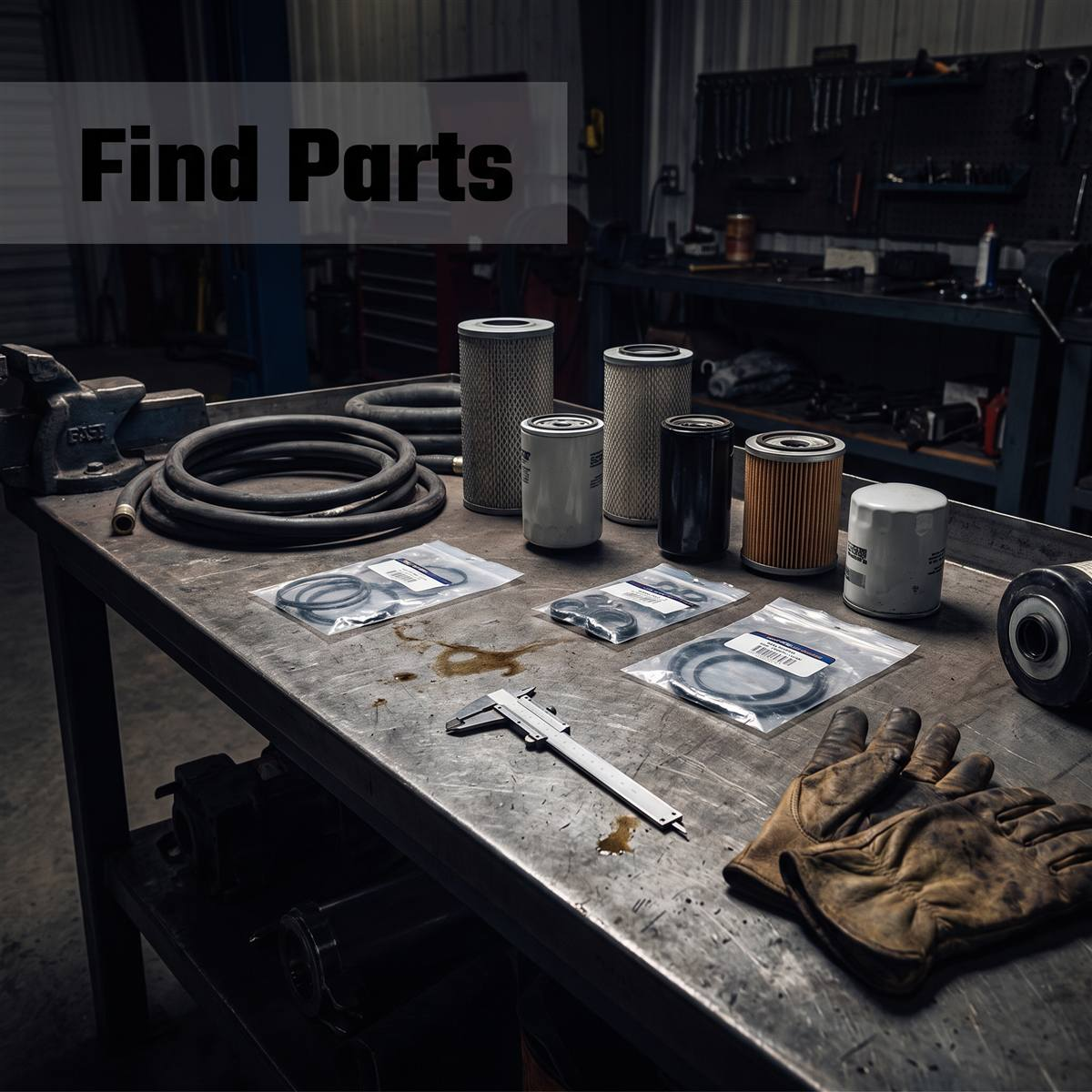
02Identify Your Exact Machine
Find this information first. It is what turns “some Chinese excavator” into a machine a parts supplier can actually help you with.
Start with the manufacturer plate, which is usually riveted to the main frame or mounted inside the cab. That gives you the model number and serial number, which is the foundation for everything else.
Then find the engine plate on the engine block itself and photograph it. This is the single most valuable photo you will take, because the engine make and model drives most of your maintenance parts — filters, belts, plugs and starters all follow from it rather than from the excavator brand.
After that, look for markings on the hydraulic pump and the travel motors. Those numbers are stamped directly onto the component or printed on a sticker attached to it, and they are what a supplier needs if you ever have to replace one of the expensive pieces.
Collect any component and casting numbers you can find while you are there, along with whatever owner and parts manuals or diagrams came with the machine. Photograph the lot and keep the images somewhere you will find them in two years, because plates corrode and stickers fall off.
03Know What Kind of Part You Need
Parts fall into five groups, and knowing which group you are in points you straight at the right supplier.
This matters because the five groups have completely different sourcing stories. Engine and electrical parts are generic and available anywhere. Undercarriage parts are sold by measurement. The expensive hydraulic components are the only ones where you genuinely depend on your seller.
| Group | What’s in it | Where it comes from |
|---|---|---|
| Engine | Oil, fuel and air filters, belts, starters and alternators, spark or glow plugs | Decided by your engine brand — any small-engine shop or online |
| Hydraulics | Hydraulic filters, hoses and fittings, seals, cylinders, pumps and valves, travel and swing motors | Hoses and seals are generic; pumps and motors need the seller |
| Undercarriage | Rubber tracks, rollers, idlers, sprockets, track components | Sold by measurement, not by brand |
| Bucket & arm | Bucket teeth, pins, bushings, linkage parts | Measure them and match — widely available |
| Electrical | Batteries, fuses, switches, sensors, wiring | Standard automotive and equipment parts |
Read that right-hand column carefully, because it is the whole argument of this page. Four of the five groups are things you can source yourself without ever contacting the company that sold you the machine. Only the expensive hydraulic components genuinely tie you to your seller, which is exactly why we tell people to test the parts story before buying.
04The Chinese Mini Excavator Parts You’ll Probably Need First
Normal wear and maintenance, not catastrophic repairs. These are the parts you will actually reach for.
The most frequent by a wide margin are the routine service items: oil, fuel and air filters, grease fittings, and hydraulic hoses. None of those is exotic, all of them are cheap, and between them they cover most of the first two years of ownership.
Next come the genuine wear items. Rubber tracks eventually need replacing on any machine that gets used, bucket teeth wear down, and pins and bushings develop play over time. These are expected costs rather than failures, and budgeting for them is part of owning the machine.
Then there are the occasional items you may or may not need: belts and a battery, track rollers and idlers, and hydraulic seals when a cylinder starts weeping.
| How often | Parts |
|---|---|
| Routine | Oil, fuel and air filters; grease fittings; hydraulic hoses |
| Wear items | Rubber tracks, bucket teeth, pins and bushings |
| Occasional | Belts and battery, track rollers and idlers, hydraulic seals |
Pins and bushings are a good illustration of the whole point. They are not exotic “Chinese excavator parts,” they are common wear components found on every excavator ever built. But fitment still has to be verified, so measure before you order. Our guide to pins and bushings covers what to measure and how to spot wear early.
05Parts for the Machines We Recommend
Because the engine drives most of your maintenance parts, here’s the quick reference for our Top 6 — then use the interactive finder below to jump straight to each part.
| Machine | Engine (most parts) | Filters From | Typical Track | Parts Ease |
|---|---|---|---|---|
| MMS MS06 | LONCIN 9.3 HP gas | Online / small-engine | Small (measure) | OK |
| CREWORKS 1-Ton | B&S 13.5 HP gas | Any small-engine shop / Amazon | ~180×72×37 | Good |
| MachPro 1.3T | Kubota Z482 diesel | Kubota dealer / Amazon | ~180×72×37 | Good |
| CREWORKS 1.3T | B&S 23 HP gas | Any small-engine shop / Amazon | ~180×72×37 | Good |
| Huayee HY14C | B&S 13.5 HP gas | Any small-engine shop / Amazon | ~180×72×37 | Good |
| TYPHON 2-Ton | Kubota D902 diesel | Kubota dealer / Amazon | Wider (~230 mm) | Good |
Don’t add a part as “compatible” because it looks similar. Match the engine part number and measure the track and pins.
06How to Measure a Part Before Ordering
A tape measure and a photograph prevent most wrong-part returns.
For pins and bushings, you want the pin diameter and the pin-to-pin centre distance, plus the bushing inner diameter, outer diameter and width. Measure the unworn section of a pin rather than the polished middle, or you will order something already undersized.
For hoses, measure the length and identify the fitting type and thread size. Taking the old hose to a hydraulic shop is faster and more reliable than measuring it yourself, and they will build a replacement while you wait.
For anything that bolts on, record the bolt pattern and the mounting dimensions before you start shopping.
Rubber tracks have their own system. The size is three numbers — width × pitch × links, written like 180×72×37. Read them off the old track, usually moulded into the inner face, and a clear photograph lets a supplier confirm the match. Our walkthrough of rubber track sizing, tension and replacement explains how to measure each number if the markings have worn away.
The rule that covers all of it: buy by the numbers, not by the logo. A supplier who has your measurements can help you. A supplier who only has your machine’s brand name often cannot.
07Don’t Trust “Fits 1-Ton Excavators”
This is the trap. Two 1-ton Chinese mini excavators don’t necessarily use the same parts. A component that looks identical can still have different dimensions, threads, bolt patterns, electrical connections, hydraulic fittings, pin sizes, and mounting configurations. “Fits 1-ton” is a hint, not a guarantee — use your actual machine info and measurements before you order.
08Where to Buy Mini Excavator Parts on Amazon (and Beyond)
Five sources, each best for something different.
| Source | Best For | Watch Out For |
|---|---|---|
| Amazon | Common maintenance/wear items — fast shipping, easy returns | Verify fitment; not every model-specific part |
| Manufacturer | Model-specific and unusual components | Slower; language/shipping |
| U.S. Dealer / Distributor | Support, warranty & technical questions | Not all brands have one |
| Aftermarket Suppliers | Tracks, filters, hoses, undercarriage | Confirm exact dimensions |
| eBay / Marketplaces | Surprisingly good availability | Careful fitment verification |
Owners consistently point to Amazon and eBay for common parts — but the same owners stress double-checking measurements instead of assuming fitment.
09Parts You Should Find BEFORE Buying the Excavator
Do this while you are still deciding, not after the machine is sitting in your driveway.
The exercise is simple: before you spend the money, go and find out where you would buy each of the parts below, and what they cost. You do not have to buy any of them. You just have to establish that they exist and are gettable.
| Category | Parts to locate or price | Difficulty is a signal |
|---|---|---|
| Routine service | Oil filter, fuel filter, air filter, hydraulic filter | Should be easy — if not, the engine story is wrong |
| Wear items | Rubber tracks, bucket teeth, hydraulic hose | Should be gettable by measurement |
| Repair items | Cylinder seal kit | Seller or specialist |
| The expensive ones | Travel motor, swing motor, hydraulic pump | This is the real test of your seller |
The whole idea: if you cannot work out where you would get a basic replacement part before you buy the machine, that is worth thinking hard about. Buy the machine based on what owning it will be like, not just on the purchase price.
10Ask the Seller for This Information
Copy, paste, and send this to the Amazon seller before you buy. How they answer tells you a lot.
Hi — before I purchase, can you please send me: exact model number, serial number format, engine manufacturer/model, parts manual, operator manual, parts diagram, hydraulic diagram, filter part numbers, track size & part number, hydraulic filter number, a common replacement-parts list with pricing, your U.S. parts warehouse info, and warranty contact information? Thank you.
A seller who answers this quickly and completely is a seller who’ll still be there when you need a part. Silence is an answer too.
11Common Parts Problems (and the Real Story)
This is not meant to scare you, just the honest potential headaches so you can spot them early.
The most common frustration is parts that are not labelled clearly, with no part numbers stamped anywhere useful. That is why photographing and measuring matters more on these machines than on a name-brand one.
The second is that suppliers change between production runs, which means “same model” is not always the same part. A machine built in spring and one built in autumn can carry different components under an identical name, and that catches people who order from a review rather than from their own machine.
Rebranded machines make this harder again, because the badge does not help you search for anything. And parts that look identical but are not will cost you a return and a fortnight, which is the specific reason we keep telling you to measure.
Beyond fitment, the practical problems are long lead times when parts ship from overseas, poor documentation, and in the worst case a seller who disappears after the sale.
Why exact identification matters so much: even very similar-looking machines can have different component configurations. That is exactly why Section 2 is the foundation of this whole page rather than a formality.
12Parts Finder: Pick Your Machine
Own one of our picks? Choose it below to jump straight to the parts that fit — filters matched to your engine, plus tracks, teeth, and more. (Still measure before you order.)
Search links point you at the right category — always confirm the exact part number or measurement against your machine before buying.
13Before You Order Any Part
Run through this before you click buy. It takes five minutes and prevents most wrong-part returns.
Start with the machine. Confirm the brand, the exact model, the serial number and the engine, because those four together are what any supplier will ask for first.
Then deal with the part itself. Find the old part number if there is one, photograph the old part from several angles, measure it properly, and compare the mounting dimensions against whatever you are about to order. If it carries hydraulic or electrical connections, confirm those match too rather than assuming.
Finally, cover yourself. Ask the seller to confirm compatibility in writing, and check the return policy before you order rather than after something arrives that does not fit.
The short version of this entire page: identify the machine, measure the part, buy by the numbers. Do those three things and sourcing parts for a Chinese mini excavator stops being the scary unknown people expect and becomes ordinary maintenance shopping.
14Final Takeaway
The cheapest excavator isn’t necessarily the cheapest machine to own.
Before you buy, spend ten minutes figuring out how you’d get the basic parts. If filters, tracks, hoses, and common wear parts are easy to source, that’s one less thing to worry about.
If nobody can tell you what fits your machine, that’s a problem worth knowing about before you hand over the money.
Not Sure Which Machine to Buy?
See the six Chinese mini excavators we actually recommend — chosen partly on how easy they are to support and get parts for.