How a Mini Excavator Hydraulic System Works: Follow the Oil
Everything the machine does is oil being pushed somewhere. Follow one drop round the loop once and jerky controls, weak lifting and overheating all stop being mysteries.
01The Short Version
Everything a mini excavator does, apart from making noise, is oil being pushed somewhere. Understand the loop and most problems stop being mysterious.
The engine turns a pump. The pump pushes oil. A control valve decides which way it goes. The oil pushes a cylinder or spins a motor, then comes back through a filter and a cooler into the tank, and round it goes again.
That is the whole thing. Five parts and a loop.
Two numbers describe it. Flow, in gallons per minute, decides how fast things move. Pressure, in PSI, decides how hard they push. People mix these up constantly, and nearly every attachment-compatibility argument comes down to somebody confusing one for the other.
And the part that actually decides whether your machine has a long life or a short one is not the pump. It is the oil, the filter and the cooler — the boring half nobody asks about. Section 8.
02The Loop: Where the Oil Actually Goes
Follow one drop of oil round once and the rest of this page makes sense.
It starts in the tank, which on a machine this size is a steel box tucked somewhere in the frame holding a few gallons.
The pump, bolted to and turned by the engine, draws it out and pushes it down a hose at pressure. The pump does not make pressure by itself, which surprises people. It makes flow. Pressure only appears when something resists that flow — a cylinder with a load on it, for instance.
The oil arrives at the main control valve. This is the block with all the hoses coming out of it, and it is the brain of the machine. Inside are spools, one per function, and your joystick decides which spool moves and how far.
From there the oil goes to whatever you asked for: a cylinder for boom, arm, bucket or blade, or a motor for swing and for each track.
Then it comes back. Through the filter, usually through an oil cooler, and into the tank. And immediately round again. On a working machine the whole volume of oil goes round every minute or two, which is why contamination spreads through the entire system almost instantly.
One more thing in the loop that matters enormously: the relief valve. Section 7.
03The Pump, and Why Yours Is Probably a Gear Pump
There are two kinds you will meet, and the cheap machines nearly all use the same one.
A gear pump is two meshing gears in a tight housing. Oil gets carried round the outside between the teeth and squeezed out the other side. They are simple, cheap, tough, tolerant of slightly dirty oil, and they move a fixed amount of oil per turn. Nearly every imported mini excavator in the 1 to 2 ton class runs gear pumps.
A piston pump uses pistons on an angled swashplate. Change the angle and you change how much oil it moves, which means the pump can deliver only what the machine is asking for instead of pumping flat out all the time. They are more efficient, far more controllable, and considerably more expensive.
Why this matters to you in practice: a fixed gear pump is always pumping its full flow whenever the engine is running. When you are not asking for anything, that oil has to go somewhere, and it goes over the relief valve or through the centre of the valve and straight back to tank. That is wasted energy, and wasted energy is heat. It is a large part of why cheap machines run hotter than expensive ones.
It also means a gear-pump machine often has two pumps, or a split pump, so that two functions can run at once without completely robbing each other. If your machine slows right down when you ask for boom and swing together, that is this.
Do not expect the listing to tell you which you have. The brand comparison covers which sellers will actually answer a technical question and which go quiet.
04The Control Valve
The most expensive thing on the machine that nobody thinks about until it misbehaves.
Inside that iron block are precision-ground spools sliding in precision-ground bores, with clearances you could not see with the naked eye. When you move a joystick, a spool shifts, uncovering ports that send oil one way and let the other side drain back to tank.
Two things follow from how tight those clearances are.
Dirt is the enemy. A particle far too small to see is large compared to the gap between spool and bore. That is the real reason the filter matters, and why topping up with oil out of an open container that has been sitting in the shed is a genuinely bad idea.
You do not take it apart in the driveway. Spools are matched to their bores. This is not a job for a workbench and optimism. Diagnose it, then hand it to somebody with the tools, and read what the parts cost before you commit so you know whether it is worth it.
How the valve behaves also decides how the machine feels in your hands, which is the other half of what your controls are doing.
05Cylinders, and the Motors You Never See
Oil pushing in a straight line, or oil going round in a circle. That is the whole output side.
Cylinders do boom, arm, bucket and blade. Oil in one end pushes the rod out, oil in the other pulls it back. Each one is a tube, a piston, a rod and a stack of seals, and the seals are the thing that eventually goes.
A cylinder that drifts — boom settling on its own with the machine shut off — is usually either a worn piston seal letting oil past inside, or a valve spool not sealing. Worth knowing which, because one is a cylinder reseal and one is a valve job.
There is a detail people miss: a cylinder is stronger pushing out than pulling back, because on the rod side the rod itself takes up some of the piston area. Less area for the same pressure means less force. It is one of several reasons the published force figures on a listing need reading carefully, which breakout force explains in full.
Motors do the turning. The swing motor spins the house, and a travel motor in each track drives the final drive. Final drives are a motor and a gearbox in one housing, and on a small machine they live down in the mud and take the worst of everything.
A track that runs slower than the other, or a machine that pulls to one side on flat ground, points at one of those. So does a swing that will go one way happily and groan the other.
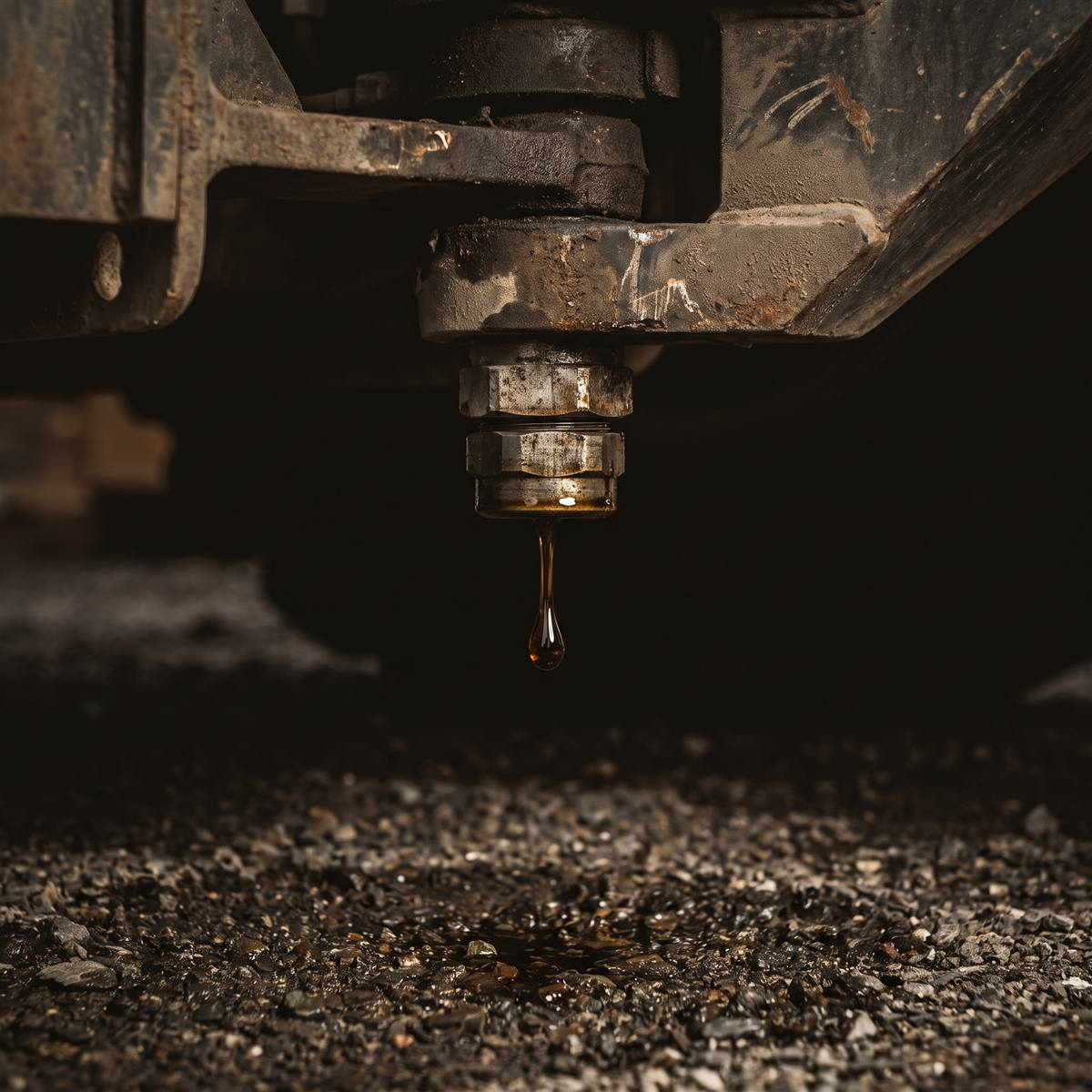
06The Auxiliary Circuit
The pair of couplers out on the arm, and the thing that decides whether you can run attachments at all.
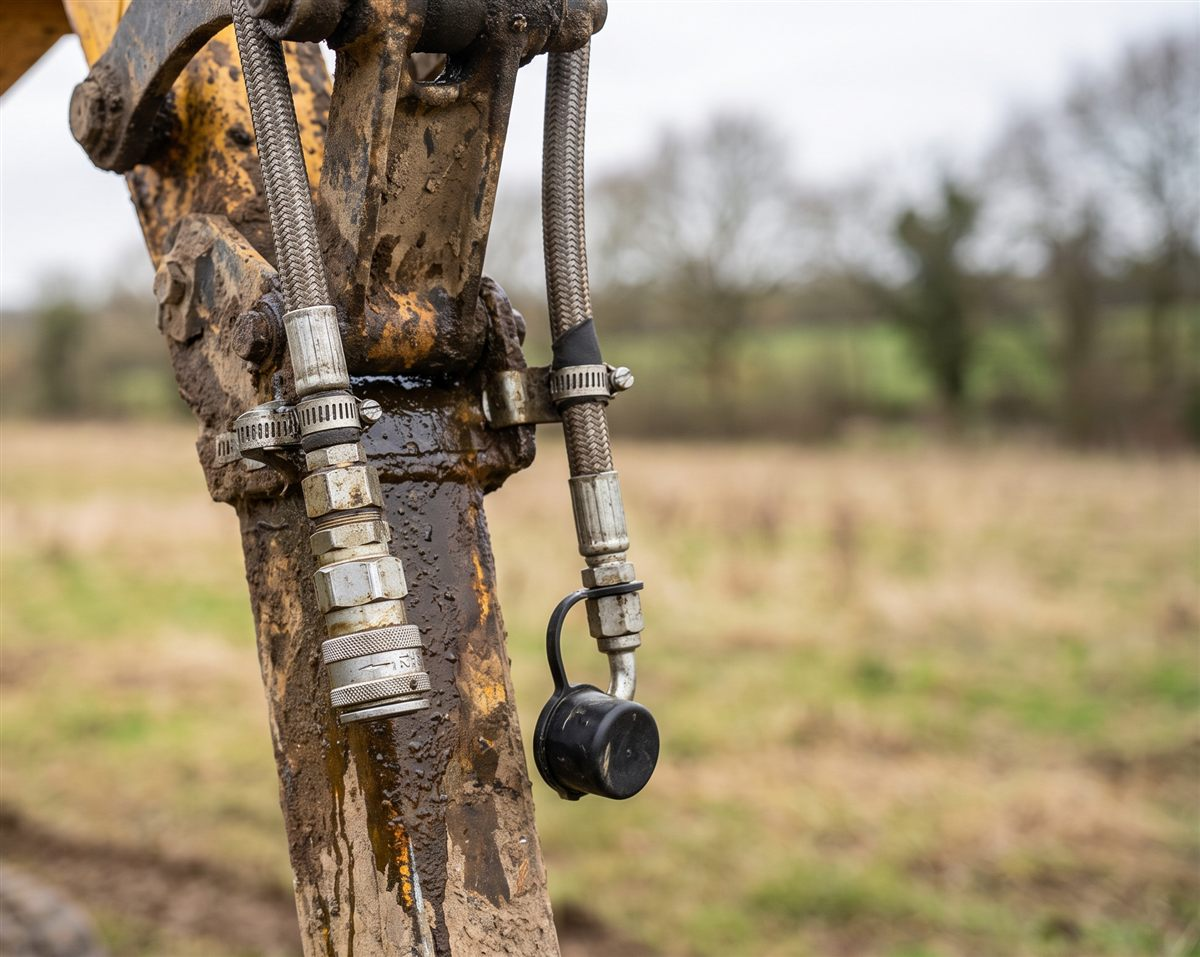
The auxiliary is just another spool in that same control valve, plumbed out to the end of the arm so you can feed something that is not part of the machine. A thumb, a breaker, an auger, a brush cutter.
Three things decide whether a given attachment will actually work on your machine, and none of them is the tonnage on the listing.
Flow. Too little and the attachment runs slow or stalls. Too much and you cook it.
Pressure. Has to be enough for the attachment to do its job without tripping your relief valve constantly.
Single or double acting. Whether oil can be sent both ways, or only one way with a return. Plenty of cheap machines have a simpler auxiliary than the attachment wants.
Finding your own numbers is a specific job with a specific method, and what flow mini excavator attachments actually need walks through it rather than guessing. The physical fit is a separate question again, covered in whether an attachment will physically fit your machine.
Whatever the circuit layout, it is all moving the same fluid — and which oil that is, and how clean you keep it decides how long the pump behind it lasts.
07Relief Valves: The Part That Saves You From Yourself
The reason you can stall the machine against a rock all afternoon and not blow it apart.
A relief valve is a spring-loaded escape route. When pressure in a circuit climbs past a set point, it opens and dumps oil back to tank rather than letting the pressure keep rising. Without it, the first time you jammed the bucket under a root something would burst, and it would be a hose or a pump, not the root.
You already know what it sounds like. That squeal or harsh buzz when you have the bucket curled hard into something that will not move is the main relief valve doing its job and telling you to stop.
Two things worth knowing.
Every drop over the relief becomes heat. Sitting on a stalled function for a minute is pouring the engine’s output straight into the oil as temperature. Hear the squeal, back off, change your approach. People who leave it screaming are the ones whose machines get hot by lunchtime, and overheating has a short list of causes with this near the top.
Do not let anybody turn it up. There is always somebody on a forum suggesting you wind the relief up for more power. The relief was set to protect the weakest thing in the circuit. Raising it does not make the machine stronger, it moves the failure from a valve that was designed to give way to a hose, a seal, or a pump that was not.
08Filter, Cooler and Tank: The Boring Half That Decides Everything
Nobody shops on this. It is what separates a machine still working in year eight from one that is scrap.
The filter. Everything that wears anywhere in the system ends up as metal in the oil, and the filter is the only thing taking it out. Change it on schedule, not when you remember. If a filter is skipped long enough it goes into bypass, which means unfiltered oil is going straight round the loop and you will not get a warning.
The cooler. A small radiator for the oil, usually stacked in front of or behind the engine one. On small machines it is often undersized to begin with, and it blocks with dust, chaff and grass seed from the top side where you cannot see it. Blowing it out backwards with an air line is ten minutes and it is the single most neglected job on these machines.
The tank. It is not just storage. Oil sitting in the tank is where air bubbles rise out and where heat sheds. A small tank means the oil gets less time to settle and cool before it goes round again, which is another reason small machines run hot.
The oil. It is not a consumable you top up, it is a working component. It carries the power, lubricates everything, and sheds the heat. Old, dirty or wrong-grade oil degrades every single thing on this page at once. Staying on a fluid and filter schedule rather than going by feel matters more on a cheap machine than an expensive one, not less, because the margins everywhere else are thinner.
Check Price on AW 32 Hydraulic Oil →
AW 32 is the common grade for small machines in most climates, but check your own manual before you pour anything in — AW 32 and AW 46 are not interchangeable everywhere, and the machine’s own spec beats anything written here.
The practical version of all of this is in the maintenance schedule that actually keeps one running.
09What This Means When You Are Buying
Four questions that tell you more about a machine than the whole spec table.
1. What is the auxiliary flow, in GPM? A seller who knows is a seller who has the documentation. A seller who answers in tons is a seller reading the same listing you are.
2. Is the auxiliary double acting? Decides half of what you can hang on the front.
3. Is there an oil cooler? Some of the cheapest machines genuinely do not have one. That is not automatically a dealbreaker on a machine doing light work in a mild climate, but you need to know, because it changes how you have to work it.
4. Quote me a boom cylinder seal kit and a hydraulic filter, now. The best question on the whole site, and it is not really about hydraulics. A real parts operation answers. “We will have to check” tells you what year three looks like.
If those four get straight answers, you are dealing with somebody who knows what they are selling.
10Questions People Ask
The ones that come up once somebody starts poking around the machine.
How much hydraulic oil does a mini excavator hold? On a 1 to 2 ton machine, a handful of gallons in the tank and a bit more out in the hoses and cylinders. Your own manual is the only honest answer, and the dipstick position matters — check it on level ground with the machine in the position the manual specifies, or you will chase a reading that was never wrong.
Can I use tractor fluid instead? No, not interchangeably. Universal tractor fluid is built for a different job including wet brakes and a transmission. Use what the machine asks for.
Why does my machine get weak when it is hot? Hot oil is thin oil, and thin oil slips past clearances instead of doing work. Some loss is normal. A machine that falls off badly has a cooling problem or internal wear.
What is that squealing when I push hard? The relief valve. Section 7. It is a warning, not a feature.
Is a two-pump machine better than one? Generally yes for doing two things at once, which is most real digging. It is rarely stated in a listing, which tells you something about who writes them.
How hard is it to add an auxiliary circuit later? Harder than a forum makes it sound. You need a spool in the valve to feed it, lines run out the arm, and a way to control it. If you know you want attachments, buy the machine with the circuit already there.
11Bottom Line
Pump makes flow, valve picks the direction, cylinders and motors do the work, and the oil is what carries all of it.
Once you can picture that loop, the symptoms stop being random. Jerky means the oil is cold or dirty. Weak when hot means cooling. Drifting means a seal. Squealing means you are on the relief and should change what you are doing.
And the thing that decides how long the whole lot lasts is not the badge on the side. It is whether the oil stayed clean, the filter got changed, and the cooler stayed clear. Those three are entirely within your control, on any machine, at any price.
When something does go wrong, work the symptoms in order rather than buying parts and hoping.