Buying a Used Mini Excavator: What To Check Before You Hand Over Money
For what a new import costs, there is a used name-brand machine sitting on a dealer lot somewhere. That is the comparison that actually matters, and the only way to judge it is to put your hands on the machine.
01The Short Answer
See it cold, on level ground, in daylight. Spend your time on the undercarriage and the hydraulics, because that is where the money is. Walk away from anything you cannot start, cannot get records for, or cannot buy parts for.
A used machine is not automatically the safer buy, and it is not automatically the cheaper one. What it is, that a new import is not, is proven. It has a history, and history is readable if you know where to look.
02The Comparison That Actually Matters
Not new versus used. It is used name-brand versus new no-name, at roughly the same money.
That is the real fork in the road and almost nobody frames it honestly, this site included until now. On one side: a new Chinese import, full warranty such as it is, nothing worn out, nobody else’s problems, and a parts supply that depends entirely on whether the seller is still trading in three years. On the other: an older Kubota, Takeuchi, Bobcat or Yanmar with real hours on it, a dealer network, parts you will still be able to buy in 2040, and somebody else’s wear already in the price.
Neither is the obvious winner. The used name-brand machine is the better machine and the better long-term bet on parts. The new import is the better bet on right now — nothing is worn, nothing is about to need doing, and you know exactly what you are getting. If you are mechanically confident and patient, the used brand-name route is usually the smarter money. If the idea of a surprise two-thousand-dollar repair in year one would ruin it for you, new has real value.
Be careful of one trap. A used name-brand machine at import money is usually a high-hour, hard-used, ex-rental machine. The bargain and the problem are the same machine. That is what the rest of this page is for.
03Settle This Before You Drive Three Hours To Look At It
Most bad trips are avoidable with four questions on the phone.
Why are you selling it? Listen to the whole answer, not the first sentence.
What has been done to it, and do you have receipts? A folder of oil-change receipts is worth more than a low number on the meter. No records at all is not automatically a no, but it changes what you are buying.
Will it be cold when I get there? If the answer is anything other than yes, you have learned something. More on this below.
Quote me a rubber track, a swing motor and a boom-cylinder seal kit for this machine, right now. This is the question that separates a real machine from a future ornament. On a name brand the dealer answers in a minute. On an off-brand import, the answer tells you whether you will be able to get parts for it at all.
Then ask for a video of it running and working. The trick that works: ask them to put today’s date and your name on a piece of paper and hold it next to the running machine. Honest sellers do it without blinking.
04Make Them Start It Cold. Every Time.
A warmed-up machine is a machine with its problems already hidden.
Hard starting, blue or white smoke that clears after a minute, a rattle that goes away, low oil pressure on a worn engine — all of that shows on a cold start and none of it shows on a machine that has been idling for twenty minutes before you arrived. If you turn up and it is already running and warm, that is information in itself. Ask them to shut it off and come back later, or come back another day.
On the cold start, watch for: how long it cranks, whether it needs starting fluid (a bad sign, and worse if there is a can sitting on the seat), what colour the exhaust is in the first thirty seconds and whether it clears, and any knock or tap that quietens as it warms. Then open the oil filler cap with it running and look for blow-by puffing out — a steady breath of smoke there is a worn engine.
Let it come up to temperature and keep watching. A machine that loses power or starts running hot once the oil warms up is telling you something about the pump or the cooling system, and that will not show in the first five minutes.
05The Undercarriage: Where the Money Hides
If you only have twenty minutes, spend fifteen of them on your knees.
This is the single biggest cost item on a used machine and the one sellers least expect you to look at properly. Tracks, rollers, idlers and sprockets wear as a set, and a machine that needs the lot is carrying a four-figure bill you are about to inherit.
What to look at. The rubber tracks — depth of the tread lugs compared to a new one, cracking in the rubber between lugs, any steel cord showing anywhere, and chunks missing off the edges. The sprocket teeth, which should be symmetrical, not hooked and pointed like a shark fin. The rollers, for oil weeping out of the seals and for flat spots. The idler at the front and how far the tensioner has been wound out — a grease tensioner screwed almost all the way out means the track is at the end of its adjustment. And heavy dents and gouges on the track frame, which tell you the machine has been worked in rock and rubble.
Then get them to track it forward and back and turn it both ways while you watch. Listen for grinding and look for a track that wants to climb or jump. What tracks and undercarriage parts actually cost is the number to have in your head before you negotiate, and a weeping final drive seal down there is the start of the most expensive failure on the machine — check both drive motors for oily residue.
06Ten Minutes of Hydraulic Checks Anybody Can Do
No tools required for most of this. Just somebody in the seat and you standing where you can see.
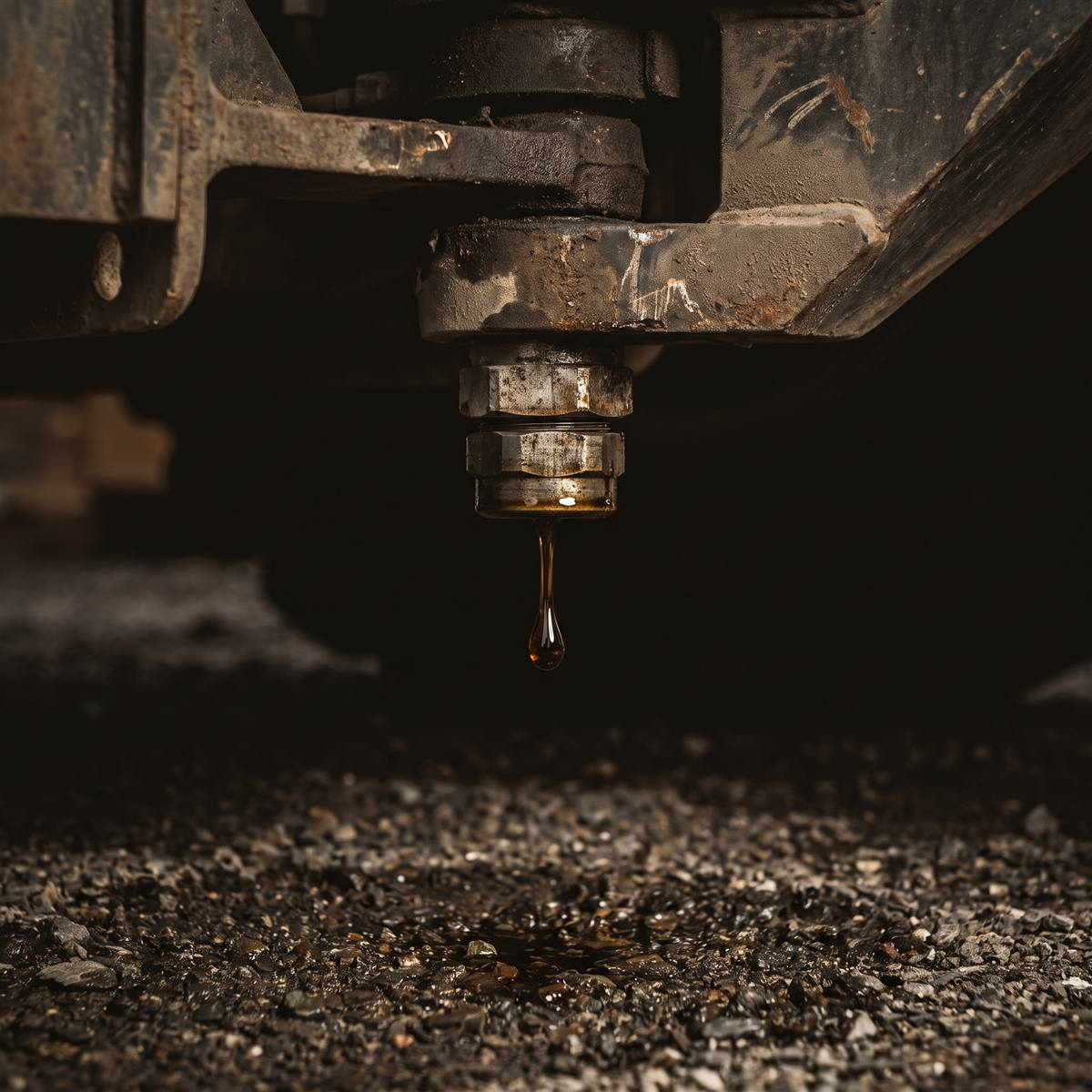
Look for leaks first, with the machine warm. Follow every cylinder rod — boom, stick, bucket, blade — and look at the gland at the end of each. A wet, dirt-caked ring there is a leaking seal. Check the hoses where they flex and where they pass over the boom. Some weeping is normal on an old machine; a drip is not.
The drift test. Lift the boom with a loaded bucket, hold it at height, stop touching anything, and watch for a minute. One trade rule of thumb treats more than about an inch of sag in sixty seconds as a worn cylinder seal or a tired control valve. That is one yardstick, not a standard — what matters more is whether one cylinder drops noticeably faster than the others.
The swing. Swing the house and let go. It should stop fairly promptly and stay put. A long coast, or the house creeping downhill on a slope, means the swing brake or motor needs attention. Then push the bucket into the ground hard enough to take weight off one side and watch the slew ring for play.
Everything at once. Ask them to boom up, curl and swing together under load. A tired pump is fine doing one thing and falls apart doing three. If the machine slows to a crawl when you ask for two functions, that is the pump talking.
If you are serious about a machine and the seller will allow it, an actual pressure reading beats all of this guesswork. A test kit is not expensive — the catch is you need the right fitting for that machine’s test port and the service spec to compare against, so this is a tool for somebody who intends to keep testing, not a one-afternoon purchase.
Hydraulic pressure test kit with gauges →
The common hydraulic failures and what each one feels like is worth reading before you go, so you know what you are feeling for.
07Pins, Bushings and Slop
Slop is the cheapest thing on this page to measure and the clearest signal of how hard the machine worked.
Rest the bucket teeth on the ground with a little down pressure, then have the operator work the bucket back and forth gently. Watch each joint — bucket to stick, stick to boom, boom to the machine. Movement you can see, or a clunk you can hear, is a worn pin or an egged-out bushing. A little is normal on an old machine. A lot means it was run dry and not greased, which tells you how the rest of it was treated.
While you are there, look at the grease fittings themselves. Fittings that are clean, intact and surrounded by fresh grease say somebody cared. Missing or painted-over fittings say nobody did. That one glance predicts more about a used machine than the hour meter does.
If you want a number rather than a feel, a cheap digital caliper measures a pin against an unworn section and tells you exactly how much is gone. It is also the tool you will want later for measuring the machine for attachments.
6 inch digital caliper, inch and millimetre →
What pin and bushing wear actually costs to put right tells you whether to walk or to negotiate.
08The Engine Claim Worth Checking
Used listings repeat whatever the original listing said. Some of what the original listing said was never true.
The one that comes up constantly on imported machines is a single-cylinder air-cooled Kubota diesel. There is no such thing. Real Kubota diesels are multi-cylinder and water-cooled, which anybody can confirm against Kubota Engine America’s own published engine range in about a minute. A seller repeating that line is either passing on a claim they never checked or hoping you will not.
So on any used machine, read the data plate on the engine itself rather than the advert. Make, model number, serial. Then search that model number. If the engine is a Chinese clone of a Yanmar or Kubota design, that is not automatically bad — plenty of them run fine — but it changes what parts cost and where they come from, and you should know which one you are buying. The gas and diesel engines these machines actually ship with is worth knowing going in.
09The Seller and the Paperwork
You are buying from a person as much as you are buying a machine.
Get a bill of sale with the machine’s serial number on it, the price, the date and both parties’ names. Photograph the data plate yourself rather than taking the seller’s word for the serial. If it is an imported machine, ask about the emissions label and certification paperwork, because a machine that cannot be registered or resold legally is worth less than one that can.
Red flags worth walking over: a seller who will not let you start it cold, a machine that is already warm with no explanation, a freshly pressure-washed undercarriage on an otherwise filthy machine, fresh paint in one small area, an hour meter that does not work, and a price far under everything comparable with a story attached to explain why.
And remember the asking price is not the cost. Add what it needs. A machine at four thousand that wants tracks and a final drive is not cheaper than one at seven that wants nothing.
10If the Used Machine Is an Off-Brand Import
Everything above still applies. Two things get harder.
Parts. With a used Kubota you are buying into a supply chain that will outlive you. With a used machine sold under a brand that existed for one product cycle, you are buying into whatever the current importer still stocks. Ask the parts question before anything else, because it is the one that decides whether the machine has twenty years left in it or two.
Records. These machines mostly get sold private-party and mostly have no service history, because the original owner bought it off a listing and serviced it himself or did not. So the machine has to speak for itself, and the undercarriage, the grease fittings and the pin slop are the only testimony you are going to get. Weight those checks heavier, not lighter, than you would on a dealer machine.
One thing genuinely works in your favour. A used import that has been owned for two or three years has already survived the period when the bad ones announce themselves. The faults that show up on these machines tend to show up early. A three-year-old one with a tidy owner and a folder of receipts has passed a test a brand-new one has not taken yet.
11What I Would Do
Go look at both. Same week, same money, and make them compete.
Find a used name-brand machine at your number and go stand on it. Then look at what that same money buys new from the import market. One of them will feel obviously right once you have seen both, and it is not always the one you expected walking in.
If you take the used route, take somebody mechanical with you, see it cold, and budget for what it needs on top of what it costs. If you take the new route, you are paying a premium for certainty and that is a legitimate thing to buy.
And if neither feels right, renting for the one project you actually have is still on the table, and it is still frequently the answer. Either way, work out what size machine the job and your trailer actually call for before you fall in love with a specific one.