What Hydraulic Flow Do Mini Excavator Attachments Need?
Gallons per minute and PSI decide whether a breaker, auger or cutter does real work or just makes noise. Here is how to find what your machine puts out, what each attachment actually asks for, and what goes wrong at both ends of the mismatch.
01The Short Version
Every hydraulic attachment has a flow range it needs to work properly. If your auxiliary circuit does not land inside that range, the attachment will still bolt on and still turn — it just will not do the job.
That is what makes this different from a pin that does not fit. A fitment problem announces itself. A flow problem hides.
People spend a season blaming a cheap attachment when the real answer is that their machine was never able to feed it.
So before you buy anything with a hose on it, you need two numbers off your own machine and two numbers off the attachment, and they have to overlap.
02Flow and Pressure Are Not the Same Thing
Flow is how much oil moves. Pressure is how hard it pushes. Attachments care about both, and they fail differently when each one is wrong.
Flow is measured in gallons per minute. Think of it as volume per unit of time — how fast the circuit can fill something.
Flow is what determines speed. An auger with enough flow spins at its designed rate. Starve it and the bit turns slowly no matter how much pressure is behind it.
Pressure is measured in PSI. It is the force the oil can exert once it gets there.
Pressure is what determines grunt. A breaker with adequate flow but low pressure will cycle at the right speed and hit like it is apologising.
The useful way to hold it in your head: flow sets the speed, pressure sets the force. You need both in range, and having lots of one does not make up for a shortage of the other.
03Finding Your Own Numbers
Harder than it should be on an imported machine, and worth the effort anyway.
Start with the data plate and whatever manual came with it. If there is an auxiliary flow figure printed anywhere, that is your starting point.
Treat it as a starting point, not gospel. Advertised figures on small imported machines have a habit of describing the pump’s theoretical output rather than what actually reaches the end of the arm.
If there is no figure at all — which is common — you have two options.
The first is to ask the seller directly, in the same way you would ask about pin dimensions. A seller who knows their product answers with a number.
The second is to measure it. A hydraulic flow meter plumbed into the auxiliary circuit gives you the real answer under real conditions, at operating temperature, with the engine at working RPM.
That is the number that matters, and it is frequently lower than the paperwork suggests.
Measure at working temperature and working RPM. A cold circuit at idle will read low and tell you nothing useful. Warm the machine up, set the throttle where you actually run it, then take the reading. That is the flow your attachment will see.
If your machine arrived with no meaningful documentation at all, you are in the same position as everyone else with an unbranded import. Working out what you actually own when the machine has no real brand behind it is the same detective job, and the answers come from the machine rather than the paperwork.
04Single Acting or Double Acting?
Before flow figures matter at all, check which kind of auxiliary circuit you have. Getting this wrong means the attachment does not work regardless of numbers.
A single acting circuit sends oil one way. Out to the attachment, back through return. That is enough for anything that only needs to be driven in one direction — a breaker, most augers.
A double acting circuit can send oil either way, so the attachment can be driven in both directions. That is what a thumb needs to open and close, and what a grapple needs to grip and release.
Plenty of small machines ship with a single acting auxiliary as standard and a double acting circuit as an option nobody ticked.
So if you are eyeing a thumb or a grapple, establish this first. It is a yes or no question and it decides whether the rest of the conversation is worth having.
Adding a second circuit is a real job, not a bolt-on. It means valves, lines and usually a controls change.
05What Each Attachment Actually Wants
Ranges vary by size and by manufacturer, so treat this as the shape of the problem rather than a spec sheet. Always check the specific attachment.
Hydraulic thumb. The gentlest ask on the list. A thumb moves slowly, holds position, and does not need much volume. Needs double acting.
It is the usual first hydraulic attachment for exactly this reason, and whether a thumb earns its place on a small machine comes down to how much you handle brush and rock rather than to flow.
Auger. Moderate flow, and this is where undersized circuits start showing. The motor needs volume to keep the bit turning under load.
An auger that spins fine in the air and stalls in clay is telling you about your flow. What it takes to actually run an auger off a mini excavator covers the sizing side in more detail.
Brush cutter. Usually the hungriest thing you can hang on a small machine. A rotary head has to keep mass spinning fast, and that is flow.
This is the attachment most often bought for a machine that cannot feed it. Matching a brush cutter to the machine you actually have matters more here than with anything else.
Breaker. Cares about pressure as much as flow, because the whole job is impact energy. Under-pressure breakers tap rather than break.
Why a breaker disappoints so many people on one-ton machines usually traces back to this exact mismatch.
Grapple. Similar ask to a thumb, and needs double acting. Low flow, but it has to hold pressure without creeping.
06What Happens With Too Little Flow
The attachment works, badly, and keeps working badly until you either fix the mismatch or give up on it.
Rotating attachments turn slowly and stall the moment they meet resistance. The auger goes into hard ground and simply stops.
Cutting attachments bog down in exactly the material you bought them for. Light brush is fine, anything with a stem in it is not.
Breakers cycle slowly and lose most of their effect, because a breaker’s output depends on hitting at its designed rate.
The frustrating part is that none of this looks like a fault. Nothing leaks, nothing screams, no light comes on. It just underperforms, consistently, and you assume you bought junk.
There is a heat cost too. A starved circuit works hard and the oil temperature climbs, which makes everything else on the machine worse.
07What Happens With Too Much Flow
Less common on small machines, and considerably more expensive when it happens.
Forcing more oil through a motor than it was designed to pass creates heat and pressure inside the attachment itself.
Seals go first. Then you are looking at a motor that leaks, and at oil in places it should not be.
Rotating attachments also over-speed, which means bearings wear far faster than they should and the whole unit runs hot.
The fix is a flow control valve that throttles the supply down to what the attachment wants. Cheap, and worth fitting the same day if your machine outruns the attachment.
These are not exotic parts. An adjustable restrictor valve sized for one to two ton machines plumbs into the auxiliary line and lets you dial the supply back to the attachment’s range. Check the thread against your own fittings before ordering.
Do not assume more is better. An attachment rated for a range means a range. Running it above the top end is not “extra performance” — it is a warranty conversation you will lose, and usually a seal kit.
08Why It All Gets Worse When the Machine Is Hot
Oil thins as it warms. Thin oil slips past internal clearances that thicker oil would have pushed through, and effective flow drops.
So an attachment that felt adequate in the first hour goes soft by the third. That is not your imagination and it is not the attachment failing.
It matters most on machines already sitting near the bottom of the attachment’s flow range, because they have nothing in hand when the oil warms up.
If you only ever test an attachment cold, you will get a flattering answer. Work it for an hour and see what you have then.
Persistent heat is worth chasing on its own account rather than tolerating. Why these machines run hot and what actually brings the temperature down is a separate problem that makes this one worse.
Hydraulic oil choice plays into it too, and so does whether the oil has been changed on anything resembling a schedule. The hydraulic faults that show up most often on these machines are overwhelmingly maintenance-driven.
None of that is specific to imported machines, either. Caterpillar’s own maintenance guidance for hydraulic systems and wear components describes the same intervals and the same failure path, on machines costing forty times as much.
09What to Settle Before You Buy
Four things. Get them all and the attachment either works or it was never going to.
Your auxiliary flow, measured or confirmed. Not the brochure figure. The number at working temperature and working RPM.
Your circuit type. Single or double acting. This one is binary and it eliminates whole categories of attachment.
The attachment’s required range, both flow and pressure. Ask for the range it needs to perform, not the minimum at which it will technically operate. Those are different numbers and sellers know it.
The fittings. Thread type and connection style, so you order adapters at the same time rather than a week later.
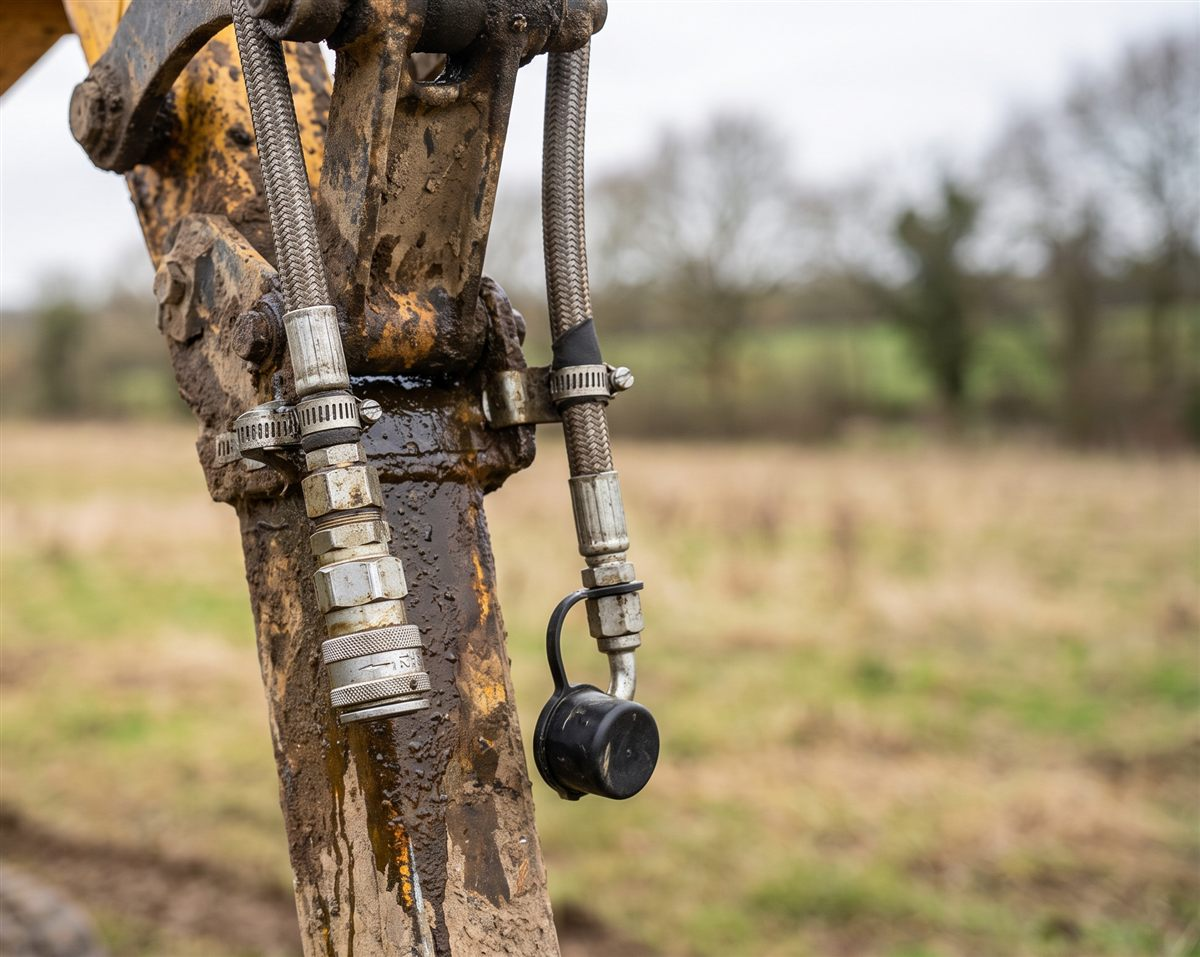
That last one is quick to check while you are already out at the machine. The measuring procedure for a mini excavator includes photographing the hose ends for exactly this purpose.
And if the seller cannot give you a flow range in numbers, you have learned something useful about the seller rather than about the attachment.
Get the Mount Right Too
Flow decides whether it works. Pins decide whether it goes on at all. Both have to line up before you spend anything.