How to Haul a Mini Excavator: Trailer, Ramps and Tie-Downs
The four-chain rule everybody quotes is written for machines over ten thousand pounds. Yours is not one. Here is what the regulation actually says, who it applies to, and why you should use four chains regardless.
01The Short Answer
Know the real weight. Use a trailer rated well above it. Load it so the heavy end sits forward of the axles. Four chains, pulled in four different directions, to real tie-down points. Blade and bucket on the deck. Stop and re-check after the first few miles.
That is the whole job. The rest of this page is the detail that stops it going wrong, and one piece of regulation that almost every article on this subject gets backwards.
02Weigh the Whole Problem, Not the Machine
The number in the Amazon listing is the machine. The number that matters is machine plus everything else.
Operating weight on a listing is usually the bare machine with a standard bucket. Add the thumb, the second bucket you are bringing, the auger, a can of fuel, the tool box and a couple of lengths of chain, and you are comfortably heavier than the figure you planned around. Then add the trailer itself, which on a decent equipment trailer is well over a thousand pounds empty.
Two plates settle the rest and neither of them is on the internet. The GVWR plate on the trailer tongue tells you what that trailer is rated to carry loaded. The sticker in your truck’s door jamb tells you its payload and towing numbers. We do not print tow ratings here because they are specific to your exact truck, and what you can legally tow is one of the three constraints that decides what size machine you should buy in the first place.
If the arithmetic is tight, it is the wrong trailer. There is no version of this where being slightly over is fine.
03What Trailer Actually Works
Capacity is the first question and deck length is the second. Most people get the first one right and the second one wrong.
A one to two ton machine wants a tandem-axle equipment trailer, not a single-axle utility trailer. The common and expensive mistake is a lightweight landscape trailer that is already near its rating with a mower on it.
Deck length has to take the tracks plus the blade sticking out front plus the tail swing behind, with the machine positioned where you need it for tongue weight — not just barely fitting corner to corner. Deck width has to take the tracks with room to sit square, not perched with a grouser hanging over the edge.
Two features worth paying for. A beavertail or tilt deck, because it turns the worst part of this job into a non-event. And proper D-rings or stake pockets rated for tie-down, welded in, not bolted-on hardware-store eyes. Your chains are only as good as what they hook to.
04Getting It Up There
If your trailer has a beavertail, skip most of this. If it is a flat deck, the ramp angle is the thing that bites.
Work it out before you buy ramps. A sixty-inch ramp reaching a twenty-four-inch deck sits at about twenty-four degrees. That is steep. A mini excavator has long tracks and not much belly clearance, so the risk is not the climb — it is high-centring at the top, where the tracks bridge from ramp to deck and the middle of the machine has nothing under it. Longer ramps make a shallower angle and a gentler transition, and they are worth the extra money.
Two things to measure before you order anything. Your deck height, because that sets the angle. And your track width, because the track has to sit fully on the ramp with room either side — a track hanging half off the edge of a narrow ramp is how a machine ends up on its side in a driveway.
Arched aluminium ramps are the usual answer for a flat-deck trailer. The pair below are rated at 6,000 lb for the set by the manufacturer and are 12 inches wide, which suits a small machine — measure your own tracks against that before you buy, because that number is a width, not a promise that it fits your machine.
Aluminium loading ramps, 60 in x 12 in, pair →
Then drive on dead straight and slowly, with the blade raised just enough to clear and the boom tucked in low. Do not try to steer on the ramps. If you are crooked, back off and start again.
05Where the Machine Sits On the Deck
Too far back and the trailer sways. That is the one that puts people in a ditch.
You want the bulk of the weight slightly ahead of the trailer axles so there is proper downward load on the hitch. A loaded trailer with its weight behind the axles lifts the tongue, takes weight off the tow vehicle’s rear wheels and starts the sway that nobody recovers from at highway speed. The conventional target is roughly sixty percent of the load forward of the axle centreline.
Which way round? Go by weight, not by habit. With the boom tucked in and the arm folded, the counterweight end of a mini excavator is usually the heavy end, so loading counterweight-toward-the-truck is the common way to get the balance where you want it. The trade-off is that you then reverse off at the job, so make sure you have the room to do that safely.
Either way the test is the same and it takes ten seconds: the trailer should sit level or very slightly nose-down, and the back of the truck should squat a little. If the tow vehicle looks like it is being lifted at the rear, the load is too far back. Move the machine forward a foot and look again.
Square it up. Tracks parallel with the trailer rails, machine centred side to side, blade down on the deck.
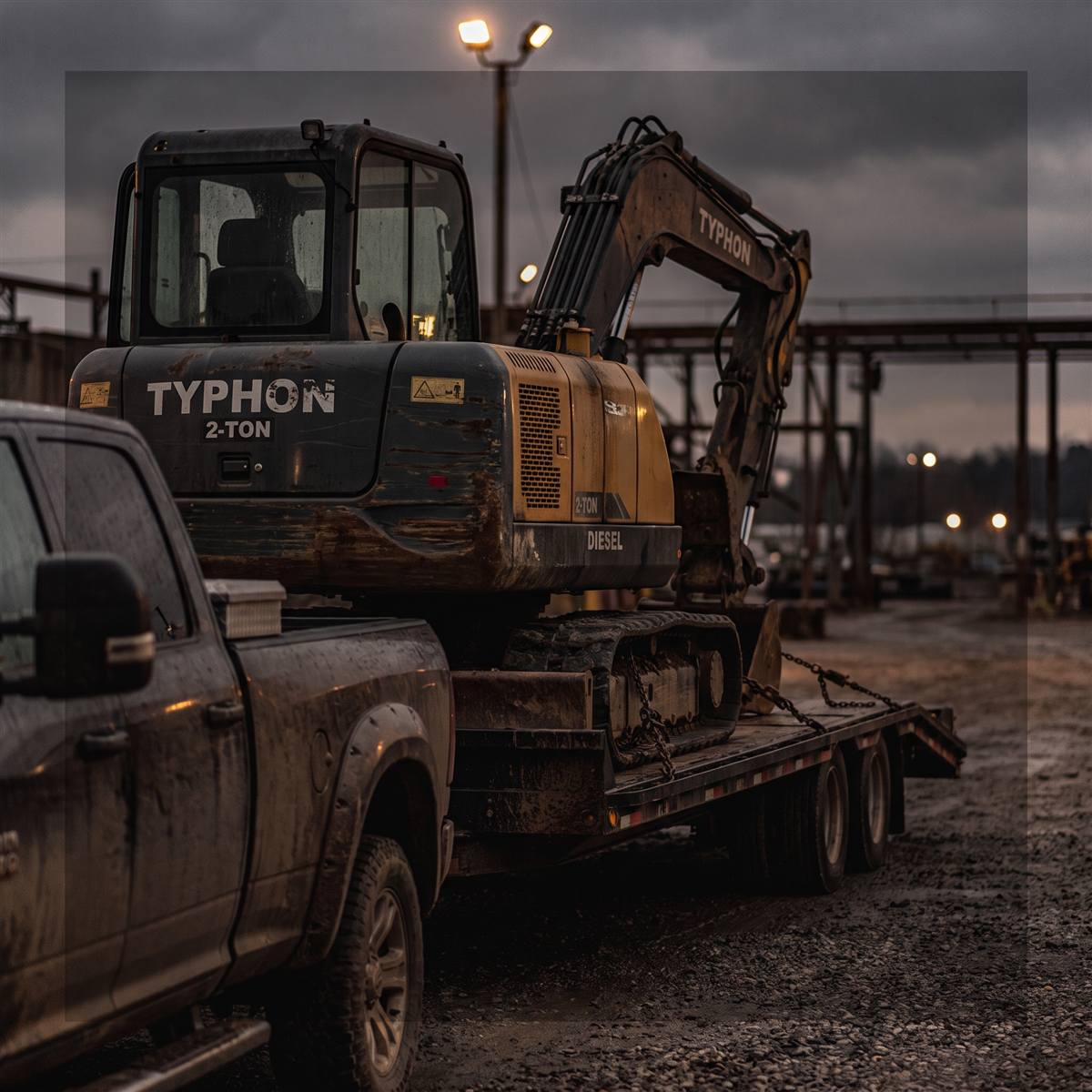
06What the Rule Actually Says, and Who It Applies To
Here is the part nearly every article on this subject gets wrong, including some written by people selling chains.
The famous four-tie-down requirement for tracked machines lives in the federal cargo securement rules, in the section on heavy vehicles, equipment and machinery. Read the applicability line and it says those requirements apply to wheeled or tracked equipment which individually weighs 4,536 kg (10,000 lbs) or more. It goes on to say that equipment lighter than that may be secured under those same rules, under the rules for automobiles and light trucks, or under the general freight requirements.
Your machine almost certainly weighs a third of that. A one-ton mini excavator is around 2,200 to 2,500 lb and a two-ton is somewhere near 4,500. So the four-chain rule people quote at you is, strictly, the rule for a machine three or four times heavier than yours, and the regulation explicitly offers lighter equipment a lower bar. You can read the federal cargo securement rules and the weight threshold that triggers each one yourself.
There is a second limit on who this reaches. Those rules are written for commercial motor vehicles operating in interstate commerce. A homeowner towing his own machine to his own back field is generally not that. But plenty of states have adopted the same securement standard for everybody, and the moment you are hauling for anything that looks like a business you are in a different conversation. We are not going to tell you which rules apply to your truck in your state — that is a phone call to your state police or DOT, same as the trailer and towing law questions that come up around registration and emissions.
None of which changes what you should do. Physics does not read the applicability section. A loose 2,500 lb machine on a trailer at highway speed is a disaster regardless of whose rule covers it. Use four.
07Four Chains, and Where They Go
Four chains, pulling in four directions, to points designed to be pulled on.
Two at the front pulling forward and out, two at the rear pulling back and out. Angled, not straight down — a chain that only pulls vertically does nothing to stop the machine sliding forward when you brake. The forward pair resist braking, the rear pair resist acceleration, and the outward angle on all four resists the machine walking sideways.
Hook to the machine’s designated tie-down points if it has them, or to solid track-frame structure if it does not. Never around a hydraulic line, never on a cylinder, never through the rubber track, and never on the blade or the boom as your primary attachment.
On working load limits, the general rule is that the tie-downs together have to be rated for at least half the weight of what you are carrying. The arithmetic is comfortable at this size: four chains with a 4,700 lb working load limit each come to 18,800 lb of aggregate rating against a machine of two or three thousand pounds. You are not short. The point of four chains here is directional restraint, not raw strength.
Grade 70 transport chain with ratchet binders is the right tool. The set below is four complete chain-and-binder sets — 5/16 inch Grade 70 at 4,700 lb working load limit per chain, with binders rated above that — which is exactly the four-point arrangement described here, in one box.
Grade 70 chain and ratchet binder kit, 4 sets →
Ratchet straps are not the answer for this. Webbing over track grousers and sharp frame edges is a cut waiting to happen, and chain does not care about the corner it is dragged across. Keep straps for the bucket and the loose gear.
08The Boom, the Blade and the Bucket
Anything that can move in transit has to be stopped from moving.
Lower the blade onto the deck. Bring the boom down and in, curl the bucket under, and set the bucket on the deck so the arm is resting rather than held up on hydraulics. Hydraulics bleed down over a few hours, and an arm that was up when you left the yard can be somewhere else by the time you get where you are going. Then set the safety lockout.
Worth knowing: for equipment under 10,000 lb on a flatbed, the federal guidance does not insist the accessory equipment be lowered flat to the deck, but it does require it to be secured against shifting with locking pins or similar. We would lower it anyway. It drops your overall height, drops the centre of gravity, and removes the question entirely.
Then deal with the loose stuff. A spare bucket, an auger, a thumb that is off the machine, a fuel can, chains you are not using. Every one of those is a projectile. Strap them down or put them in the truck, and if you brought attachments that came off the machine, remember the pins and the bucket are heavy enough to go through a rear window.
09Before You Pull Out, and Again at the End of the Road
Chains settle. The load that was tight in the yard is loose a mile later.
Walk a full lap. All four binders tight and the handles secured so they cannot flip open. Nothing resting on a hose. Lights working, safety chains crossed under the tongue, coupler latched and pinned. Tyre pressures on the trailer, which nobody checks and which is the usual cause of a blowout on a trailer that sat all winter.
Then drive to the end of the road, pull over, and walk it again. Everything will have settled a little and at least one binder will want another click. Check again at your first stop. This takes two minutes and it is the difference between a trailer that arrives and one that makes the news.
If any part of the trip is on public road, the rest of the normal rules are still yours — lights, width, speed, and the fact that you are now substantially heavier and longer than you drive every day. Extension guidance on moving equipment safely on public roads is a sober read if you have not towed much.
10Unloading Is When People Get Hurt
Everybody is careful loading. By the time they unload they are at the job and in a hurry.
Park on level, solid ground. Not a slope, not soft shoulder, not a gravel driveway with a crown. Chock the trailer wheels and leave it coupled to the truck — an unhitched trailer with a machine walking off the back of it will tip.
Take the chains off last, after the ramps are set and pinned, so nothing can roll while you are bent over behind it. Then drive off slowly and straight, with the boom tucked and the blade just clear. Ramps that are not pinned or hooked can kick out sideways as the weight transfers, which is exactly the moment you least want it.
And nobody stands behind or beside the machine while it comes down. Not to guide you, not to watch. If you need a spotter, they stand where you can see them and well clear.
11What I Would Do
Buy a trailer with more capacity than you think you need, buy four chains, and stop at the end of the driveway.
People spend months choosing a machine and then haul it on whatever trailer is in the yard. The trailer and the chains are maybe a tenth of what the machine cost and they are the part that can hurt somebody else. If the budget is tight, this is not where to save it.
If hauling it yourself is starting to sound like more trouble than it is worth, that is a legitimate conclusion — and it is worth folding into the buy-versus-rent arithmetic before you commit, because a rental yard delivers. For the first trip, when the machine is new to you, read what to expect when the machine is delivered and what to check before you sign for it.