Mini Excavator Winter Storage: How To Put It Away So It Starts in Spring
Your machine spends far more of the year sitting than working, and sitting is harder on it than digging ever was. An hour in November is the difference between turning the key in April and spending a Saturday on the phone to a parts counter.
01The Short Version
Run the fuel decision, put a maintainer on the battery, retract the rods, grease everything, wash the undercarriage out, and park it under a roof. An hour, maybe two.
Nearly every spring starting problem is a winter storage problem that nobody noticed in November. The machine does not break over the winter. It gets ruined slowly by stale fuel, a flat battery, water in places water should not be, and a mouse that found somewhere warm.
02Sitting Is the Hard Part, Not the Digging
Do the arithmetic. If you put sixty hours a year on it, that is eight thousand seven hundred hours of not running.
Sitting is the machine’s normal state and everything about storage follows from that. A machine that works every day keeps oil moving over seals, keeps rods wiped clean, keeps the battery charged by its own alternator and keeps fuel turning over before it goes off. Park it in October and every one of those protections stops.
It is also why hours are a poor guide to condition on a private machine. A low-hour machine that sat badly for five winters can be in worse shape than a high-hour one that worked. What actually ends these machines is rarely wear, and neglect over winter is a big slice of the rest.
03The Fuel Decision, Which Depends On Which Engine You Have
Gas and diesel want opposite things. Getting this backwards causes most of the spring grief.
If it is a gas machine, the enemy is the fuel going off and the ethanol in it pulling water out of the air. Modern pump gas does not keep. Left in a carburettor over a winter it turns to varnish, and varnish in the tiny passages of a small-engine carb is the single most common reason one of these will not fire in spring. Briggs & Stratton, who build the engine in a lot of these machines are blunt about what untreated fuel does over a layup.
Two ways to handle it and you pick one. Either treat a full tank with a stabiliser and run the engine five or ten minutes so the treated fuel reaches the carburettor, or drain the tank and run the carb dry. Treating is easier and it keeps the tank full, which is what you want for condensation. Half-measures — treating the tank but never running the engine — leave untreated fuel sitting in the carb, which is exactly the part that matters.
Storage fuel stabiliser, 16 oz →
If it is a diesel machine, the enemies are different: water condensing in the tank, and the fuel gelling if you are somewhere that gets properly cold. Fill the tank right up before you park it — a full tank has no room for damp air — and if the machine might be asked to start on a cold morning, an anti-gel supplement is cheap insurance. Diesel fuel also grows biological growth in the presence of water, which is a tank and filter problem rather than a carb problem.
Anti-gel diesel supplement with cetane boost, 64 oz →
Not sure which you have, or still choosing? The differences between the gas and diesel machines on the market covers more than just storage.
04The Battery
A lead-acid battery left to sit flat does not come back. It sulphates, and sulphation is not a charging problem, it is a dead battery.
Two options. Pull the battery and bring it somewhere that does not freeze, or leave it in and put a maintainer on it. A maintainer is not a charger — it watches the voltage and gives the battery small top-ups, which is exactly what a battery sitting for five months needs and exactly what a big fast charger does badly.
12V battery maintainer, 750 mA →
If there is no power where the machine lives, disconnect the negative terminal so the machine’s own clocks, relays and controllers are not quietly drawing it down. And clean the terminals before you put it away — corrosion grows all winter, and a surprising share of no-start calls are a bad connection rather than a bad battery.
05Cylinder Rods and Seals
Those polished chrome rods are the most expensive thing on the machine to neglect, and protecting them is free.
Any length of rod left sticking out of its cylinder is exposed steel. Over a damp winter it pits and rusts, and the first time you move that cylinder in spring the rust goes straight through the seal. Then it weeps forever and you are buying a seal kit.
So before you shut it off for the last time, retract the rods. Curl the bucket fully in, pull the stick in, and bring the boom down so the bucket and the blade are resting on the ground. That tucks most of the chrome back inside the barrels where it is sitting in oil. Any rod that has to stay exposed — usually some of the blade cylinder — gets a wipe of grease or a light film of oil.
Resting the attachments on the ground matters for a second reason. Hydraulics bleed down over months, and a boom left in the air will come down on its own schedule, not yours.
06Hydraulic Oil, and the Water You Cannot See
A hydraulic tank breathes. Warm days and cold nights pull damp air in and leave the water behind.
That is why a machine that sat all winter can have noticeably worse oil in April than it had in October, without doing a minute of work. Water in hydraulic oil shows up as a cloudy, milky look on the dipstick or in the sight glass, and it is bad news for pumps and valves.
You cannot stop a tank breathing, but you can make it breathe less. Park it somewhere with a stable temperature rather than out in the open where it swings thirty degrees a day. Make sure the tank breather or filler cap is clean and sealing. And if the oil is anywhere near its change interval in autumn, change it before the layup rather than after — fresh oil sitting all winter beats tired oil sitting all winter. Which oil, how often, and how to change it is a job in itself.
If it already looks milky, that is a now problem, not a spring problem. Water and contamination in the system only gets more expensive the longer it runs.
07Grease It, Wash It, Clean the Undercarriage Out
Grease is not only lubrication. It is what fills the joint so water cannot sit in it.
Hit every zerk until fresh grease shows at the joint. That pushes out whatever water and grit got in during the last job and leaves the pin sitting in clean grease for five months instead of slowly rusting in dirty grease. It is ten minutes and it is the highest-value thing on this page.
Pistol-grip grease gun, 6,000 PSI →
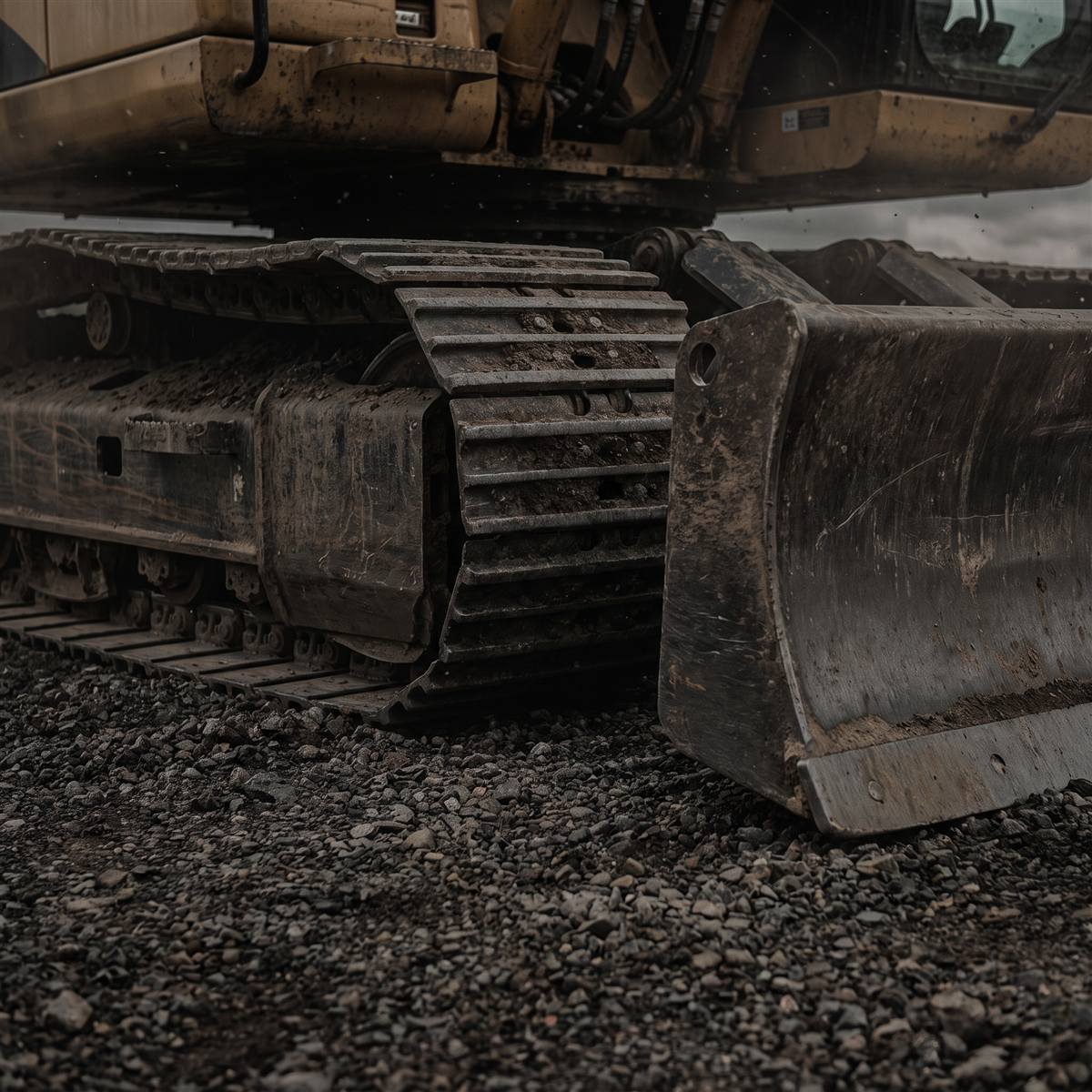
Then deal with the undercarriage. Packed mud holds water against steel all winter and freezes and thaws in it. Get the dirt and stone out from around the sprockets, rollers and track frame, and wash it if you can. While you are down there, look at the track tension and at the condition of the rubber tracks themselves — cracks you can live with in October are splits by April.
One warning: do not put a pressure washer lance straight at seals, bearings or electrical connectors. You will drive water into exactly the places you are trying to protect.
08Mice Eat the Expensive Things
A machine parked in a quiet barn is a heated, sheltered, pre-built house with chewable wiring in it.
This is not a joke item. Rodents nest in engine bays, build in air filter housings, pack insulation into radiator fins and chew wiring looms, and a chewed harness on an off-brand machine means tracing a circuit you have no diagram for. The damage is usually found in April, at the worst possible moment.
What works: block the obvious openings, leave the machine clean rather than storing it with food-smelling debris on it, keep bait or traps around where the machine lives rather than inside the engine bay, and most importantly open the engine cover and look every few weeks. A nest you find in December is a two-minute job. The same nest found in April has already cost you a harness.
09Where You Park It Beats Everything You Do To It
If you only do one thing off this page, put a roof over it.
Inside a shed or barn solves condensation, rust, UV on the rubber and seals, and most of the water problems in one move. If there is no building, a carport or lean-to is the next best thing, because the goal is to keep rain and snow off while still letting air move.
A tarp strapped tight over a machine is the worst of the options and is frequently worse than nothing. It traps moisture underneath, holds it against the paint and the seals, and keeps everything damp for months. If a tarp is genuinely all you have, use a breathable cover, leave the bottom open, and keep it off the surfaces.
Park on something firm. A machine that sits all winter on soft ground settles unevenly, and tracks sitting in standing water or in a frozen puddle are worse off than tracks on gravel.
10Bringing It Back Out
Do not climb on, turn the key and start digging. Ten minutes in spring protects the hour you spent in autumn.
Walk around it first. Look for fresh drips under the machine, chew marks and nests, tracks that have taken a set or gone flat on one side, and anything that has rusted. Check every fluid level before you crank it, because a slow leak over five months empties things quietly.
Reconnect or refit the battery, then start it and leave it at idle for several minutes. Cold, thick oil and a hydraulic system that has not moved since October do not want full throttle. Then cycle every function slowly through its full travel, several times. That wipes the rods, moves oil over every seal and tells you quickly if something is weeping.
Grease everything again before the first real job, check the track tension, and only then go and work it. If it fights you on the first start, the usual no-start causes after a layup walks through them in order, and the full service schedule is worth a look at the same time since you are already standing there.
11What I Would Do
Pick an afternoon in November, do the whole list once, and write down what you did.
The honest version is that nobody does all of this every year. If you are only going to do three things: treat or deal with the fuel, put the battery on a maintainer, and retract the rods under a roof. Those three cover most of what actually goes wrong.
And if the machine is going to sit for more than one season — a year, two years, between projects — take it seriously rather than treating it as a longer winter. Start it and cycle everything for ten minutes once a month. A machine that never moves is the one that needs a pump, and that bill lands on a machine you were not even using.