Quick Attach vs Pin-On on a Mini Excavator
A coupler buys you speed and costs you reach, capacity and a few hundred dollars. Whether that trade is worth it depends almost entirely on how often you swap, and most people guess wrong about their own habits.
01The Short Version
If you swap attachments more than about once a week, a coupler pays for itself in saved afternoons. If you mostly run a bucket and change it a few times a year, it does not.
That is the honest answer, and it has very little to do with the coupler itself.
Pinning an attachment on directly takes fifteen or twenty minutes, involves driving out pins that may not want to move, and usually needs a second pair of hands or some creative lining up with the machine.
A coupler turns that into under a minute without leaving the seat, or a couple of minutes if it is the manual kind.
The cost is money up front, a little reach and capacity permanently, and one more thing that can go wrong.
02What a Coupler Actually Is
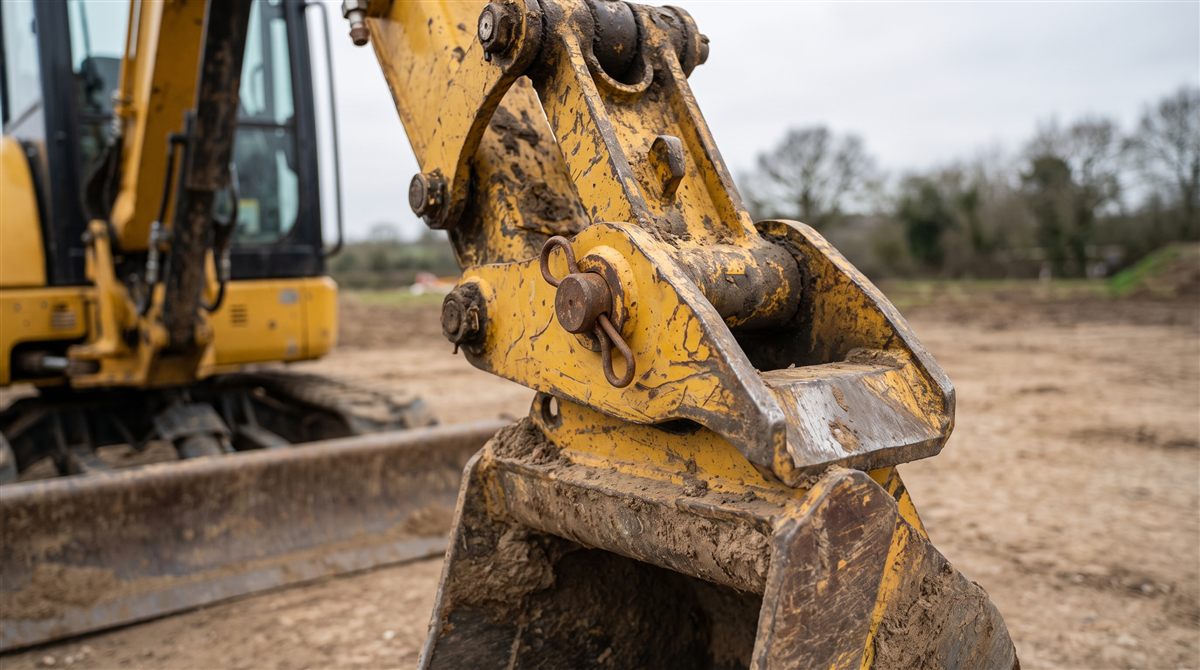
A piece of steel that pins to your arm once, and that every attachment then hangs off instead.
It moves the connection point. Your arm carries the coupler, the coupler carries the bucket.
That is the whole idea, and it has one consequence people miss. You still have to get the coupler right for your machine, using the same four measurements that any pin-on attachment needs.
After that, your attachments have to match the coupler rather than the arm. So you have not escaped fitment, you have moved it to a different piece of steel — one that you now buy attachments to suit.
Worth knowing before you commit: the good coupler listings put the pin size in the title. A 25mm coupler built for 0.8 to 2 ton machines tells you what it fits before you have to ask, which is the behaviour you want from anybody selling you steel.
If you have not taken your machine’s numbers yet, the step-by-step procedure for measuring your machine safely takes about half an hour and you need it before you can shop for a coupler at all.
03Mechanical or Hydraulic?
Two kinds. One needs you to get off the machine, one does not, and the price gap between them is significant.
Mechanical. You line up, drop into the attachment, then climb down and throw a lever or drive a locking pin by hand.
Simple, cheap, almost nothing to fail. The whole mechanism is a wedge and a pin, and you can see with your own eyes whether it is engaged.
Hydraulic. A switch in the cab drives a cylinder that locks the attachment. You never get off the machine.
Faster, obviously. It also needs a spare hydraulic circuit, which on a lot of small imported machines is the same circuit you were planning to run a thumb or a breaker off.
That is the catch nobody mentions. On a one-ton machine with a single auxiliary circuit, a hydraulic coupler may be competing with the attachment you bought it to swap.
For most owners on small machines, mechanical is the right call. The thirty seconds you save is not worth the plumbing.
04What It Costs You
Money, and then a second cost in attachments that people forget to add up.
The coupler itself is the obvious expense, and on small machines it is usually in the same range as a decent bucket.
Then comes the part that stings. Attachments you already own were cut to pin straight to your arm. They do not automatically fit the coupler.
Sometimes they can be adapted. Sometimes they need new ears welded, which is structural work on a load-bearing part and not a Saturday job.
Sometimes the honest answer is that your existing bucket stays pin-on and you buy a new one for the coupler.
So the real question is not what a coupler costs. It is what a coupler plus re-fitting everything you already own costs, measured against how many hours of pin-driving it saves you per year.
Do the arithmetic before you buy. Count how many times you actually swapped attachments last season. Not how many times you meant to — how many times you did. Multiply by twenty minutes. If the answer is under a few hours, the coupler is buying you convenience, not time.
05The Reach and Capacity Hit
A coupler sits between the arm and the attachment, so it pushes everything further out and adds weight at the worst possible place.
Both of those work against you, and on a small machine there is not much margin to give away.
The extra length changes the geometry. Your bucket now sits further from the pivot, which means it curls through a slightly different arc and digs a little differently than you are used to. Most people adjust within an hour.
The weight is the part that actually matters. Every pound of coupler is a pound of lift capacity you no longer have, and it is hanging at full reach where capacity is already at its lowest.
On a machine that was comfortable with a given attachment before, adding a coupler can put the combination right at the edge.
This is the same arithmetic covered in why an attachment can pin up perfectly and still be a bad idea, and a coupler is simply another thing to put on that side of the scale.
06The Safety Question Worth Taking Seriously
A coupler adds a failure mode that a pinned attachment does not have. It can let go.
A pinned bucket is held by two steel pins through matched holes. For it to come off, something has to break.
A coupler holds the attachment with a mechanism. Mechanisms can be left half-engaged, can wear, and can be defeated by a locking pin somebody forgot to drop back in.
The result of that is an attachment on the ground, and potentially on something you did not want it on.
So the habit that goes with a coupler is simple and non-negotiable. Every single time you connect, curl the attachment fully in and set it down hard against the ground before you lift anything or swing anywhere.
If it is not properly latched, you will find out with the attachment eighteen inches off the dirt instead of over your feet.
Visually confirm the lock too. On a mechanical coupler you can see the wedge seated and the pin through. Look at it. Every time.
Federal rules for material handling equipment on job sites cover this kind of thing for contractors. On your own property the rule is the same, it is just you enforcing it.
07When Pin-On Still Wins
More often than the marketing suggests, particularly on small machines doing property work.
If you own one bucket and a thumb and that is the whole collection, a coupler solves a problem you do not have.
If you are working at the top of your machine’s capacity already, giving up weight and reach for convenience is a bad trade.
If your machine has one auxiliary circuit and you want a hydraulic attachment on it, a hydraulic coupler is going to fight you for that circuit.
And if you are buying attachments second hand, pin-on gives you a wider market. Every coupler standard narrows what you can shop for.
There is also the simple durability argument. A pinned joint is two pins and two bushings. There is very little there to go wrong, and when it does, pin and bushing wear is cheap and obvious to catch early.
08How to Actually Decide
Answer three questions honestly and the choice makes itself.
How many times did you swap last year? Be truthful. Under about a dozen and the coupler is a comfort purchase, which is fine, but call it what it is.
How close to capacity do you normally work? If you are regularly at the limit, do not spend capacity on a coupler.
How many attachments do you own, and would they need modifying? Two attachments and a coupler that fits neither is a much bigger project than it looks on the order page.
For most people on a one to two ton machine doing their own property, the answer lands on pin-on for the first year or two, then a coupler once the attachment collection has grown enough that swapping has become a real chore.
Which is a perfectly good way to do it. Buy the coupler when the swapping annoys you, not because a listing said it would.
Either way, know your numbers first. And if you are still working out which attachments belong on a small machine at all, the full rundown of what each attachment is genuinely good for is the better place to spend your money before a coupler is.
Measure Before You Order Anything
A coupler has to fit your machine before your attachments can fit the coupler. Here is the half-hour procedure that gets you the numbers.