How Long Does a Mini Excavator Last? Hours, Years, and What Actually Kills Them
Everybody quotes ten thousand hours. Run the arithmetic on your own property and you will find you could not wear one out in a lifetime. So something else ends these machines, and it is worth knowing what.
Most of that list gets done in one afternoon in autumn. The full winter layup routine goes through it in order.
01The Short Answer
The trade puts a well-kept mini excavator somewhere around 8,000 to 10,000 hours. At the fifty to a hundred hours a year a property owner actually puts on one, you will be dead before the machine is. Hours are not your problem.
What ends a machine on a private property is almost never wear. It is a repair bill bigger than the machine is worth, a part nobody stocks any more, an undercarriage that costs more than the thing is worth, or ten years of sitting outside with water in the hydraulic oil. Every one of those is avoidable, and none of them are measured in hours.
02Where the Ten-Thousand-Hour Number Comes From
Worth saying plainly: that figure is a trade rule of thumb, not the result of a standard test.
Dealers, resellers and inspection outfits mostly land in the same place — a good mini excavator looked after properly runs to around 10,000 hours, and hard use with poor servicing drags that down toward 8,000. Some sellers stretch it to 12,000. Nobody publishes the methodology, because there is not one. It is accumulated trade opinion about name-brand machines, and the people saying it usually have equipment to sell.
Two things the number hides. First, the engine commonly outlives everything around it — by the time a diesel is genuinely worn out, the hydraulics and the undercarriage have already had money spent on them more than once. Second, the figure describes machines that get serviced on schedule in a commercial fleet. It says nothing about a machine that did forty hours last year and then sat under a tarp.
So treat 10,000 hours as what it is: a ceiling nobody on this site will ever reach, quoted by people with a stake in the answer.
03Now Do the Arithmetic On Your Own Property
This is the part that reframes the whole question, and it takes thirty seconds.
Be honest about your hours. A big first year — driveway, drainage, a pond, a pad, clearing — might put 100 to 150 hours on a machine. After that, most people settle into something like 30 to 60 hours a year. Call it 60 a year as a generous long-run average.
At 60 hours a year, 8,000 hours takes a hundred and thirty years. Even if you ran it four times that hard, 240 hours a year, every year, you are still looking at better than thirty years of service. A contractor can burn 1,500 hours a year and reach the end of that machine in five. You cannot.
Which means the right question is not how many hours will it last. It is how many years will I be able to keep it running, and those are completely different problems with completely different answers.
04So What Actually Ends One?
Four things, in roughly the order they show up.
A repair worth more than the machine. This is the big one on a cheap import. A hydraulic pump, a final drive or a swing motor can be a serious fraction of what you paid, and on a five or six thousand dollar machine the arithmetic turns against you fast. Final drives and swing motors are the two that write the big cheques, and both give warning before they go.
A part nobody has. Covered in its own section below, because on an off-brand machine this is the actual life expectancy.
The undercarriage. Tracks, rollers, idlers and sprockets wear as a set, and when the whole set is due at once the bill is real money.
Neglect. Water in the hydraulic oil, a seized swing bearing, rusted cylinder rods, rodents in the harness. None of that is wear. All of it is what happens to a machine that lives outside and gets run twice a year.
05The Undercarriage Is the Clock That Actually Runs
If anything on your machine ages in hours rather than years, it is down there.
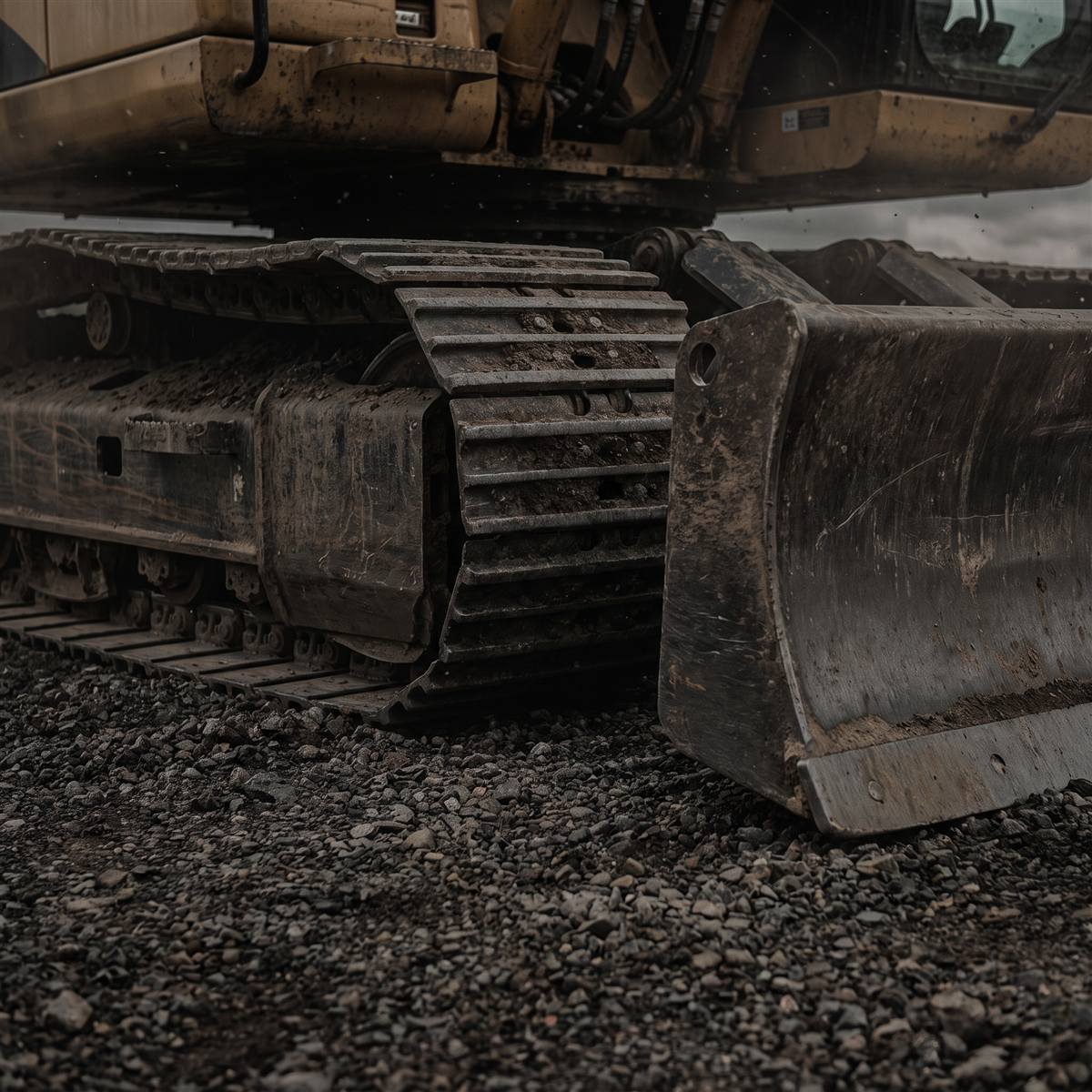
Rubber tracks are a consumable. The figures the trade quotes land around 1,500 to 2,500 hours for tracks that are kept at the right tension and cleaned out, and roughly 900 to 1,200 for tracks that are not. Again — supplier numbers, not a standard, and wildly dependent on what you drive over. Gravel, rebar, concrete rubble and stumps eat tracks. Dirt and grass barely touch them.
The controllable half is bigger than people think. Tension set wrong in either direction wears everything faster. Mud and stone packed into the sprocket grinds the drive lugs off. Spin turns, side hills and climbing kerbs tear the edges. None of that is the machine being cheap — it is how it gets driven. What a set of tracks costs and how to get the tension right is worth reading before you need it, not after.
06On an Off-Brand Machine, Parts Are the Life Expectancy
A machine is finished the day you cannot buy the thing that broke. That date has nothing to do with the hour meter.
A thirty-year-old Kubota still has parts because Kubota still exists and a parts network grew up around it. A machine sold under a brand that was invented for one Amazon listing and retired two years later does not have that. The castings may still be made in Jining — but if nobody in the States stocks them and the seller has moved on, you own a very heavy lawn ornament.
This is why the question of who is actually behind the brand matters more than the spec sheet, and why the right question to ask a seller before you buy is the parts question: quote me a rubber track, a swing motor and a boom-cylinder seal kit, right now. A real parts operation answers. The good news is that a lot of what breaks is generic and can be sourced without the brand name — filters, hoses, seals, pins, bushings, engine parts. It is the big castings and the proprietary bits that strand a machine.
07Sitting Is Harder On It Than Working
Run the numbers again. Sixty hours of work a year means eight thousand seven hundred hours of sitting. Sitting is the machine’s normal condition, not the exception.
What sitting does: fuel goes stale and gums the carburettor on a gas machine or grows bugs in a diesel tank. Seals that are not moving dry out and take a set, then weep when you finally use it. Exposed cylinder rods rust where they sit proud, and that rust cuts the seal on the next stroke. Hydraulic oil pulls moisture out of the air through the tank breather. Batteries sulphate. Mice build nests in the engine bay and eat wiring.
Three cheap habits cover nearly all of it. Retract the cylinder rods when you park so the chrome is inside the barrel. Keep it under a roof, or at least a cover that breathes, rather than a tarp that traps condensation. And start it and cycle every function for ten minutes once a month, which moves oil over every seal and gets the rods wiped. Most of the starting problems people blame on a cheap machine are really the bill for a winter of sitting.
08Hour Meters Lie. Here Is What To Read Instead.
The hour meter is the first thing people look at and the easiest thing on the machine to misread.
Start with the ratio, not the number. Divide hours by age. A machine averaging well over a thousand hours a year has been earning a living, whatever its total looks like. A low total on an old machine is not automatically good news either — that is a machine that sat, and you just read the section on what sitting does.
Then check whether the meter agrees with the machine. Worn-smooth grips on the joysticks, a flattened seat, polished paint where boots go, and slop in the bucket pins all say hours. If those say a thousand hours and the meter says two hundred, something is wrong — meters get replaced, and they get rolled back. A meter that does not run at all is its own answer.
If your machine came without a working meter, fit one. You cannot service on a schedule you cannot measure, and a vibration-triggered unit zip-tied near the engine does the job for the price of a tank of fuel.
Vibration-triggered hour meter for small engines →
Hours matter most when you are buying somebody else’s machine. The full inspection routine for a used mini excavator goes through what to check and in what order.
09How To Get Twice the Life Out Of It
None of this is clever. All of it is the stuff people skip.
Grease every pin, every working day. Not weekly. Dry pins wear oval, and the slop that creates never comes back out of the machine.
Pistol-grip grease gun, 6,000 PSI →
Change hydraulic oil and filters on the manual’s schedule, not when it looks dirty. Hydraulic oil is dirty long before it looks it, and the pump pays for that. A manufacturer’s own view of what scheduled maintenance is for makes the same point in blunter terms.
Check the final drive gear oil. Most owners never learn it exists. It is a small sealed reservoir in each track motor, and once a seal starts weeping, water gets in and the gears are finished.
Wash the undercarriage out. Packed mud holds water against steel and grinds the drive lugs.
Keep the bolts tight. Track bolts, blade mounts, counterweight. Re-torquing after the first few hours and then periodically is the cheapest maintenance on the machine.
Park it inside. Of everything on this list, a roof probably adds the most years for the least money.
10What I Would Do
Stop shopping on hour ratings and start shopping on whether you can still buy parts in ten years.
If you are choosing between machines, the hour figure in the listing tells you almost nothing about how long yours will last, because you are not going to run it the way the figure assumes. What tells you something is whether there is a real company behind it, whether somebody in this country stocks the expensive castings, and whether the thing will live under a roof.
Keep up the grease, the filters and the undercarriage, give it somewhere dry to sleep, and a cheap import will outlast your interest in digging. Skip those, and it will not see ten years no matter what the hour meter says. The machine is rarely what quits — most of what goes wrong is fixable and predictable, and what it is worth when you sell tracks how well you did all this far more than it tracks the hours.