Building and Fixing a Gravel Driveway With a Mini Excavator
A gravel driveway is a drainage structure that happens to have cars on it. Get the water off it and it lasts for years on very little stone. Get that wrong and no amount of gravel will save you.
01The Short Version
Water is the whole job. Crown the surface so water runs off sideways, cut ditches so it has somewhere to go, and put a culvert anywhere it has to cross. Then put stone on top.
Most people do it in the opposite order. They buy a load of gravel, spread it over a flat wet driveway, and in eighteen months they are buying another load. The stone was never the problem.
Your excavator is the right machine for the drainage half — ditches, culverts, stumps, base work, cutting into a bank. It is the wrong machine for the finish grading, and we will be straight about that below.
02A Driveway Is a Drainage Structure With Cars On It
Once you see it that way, every decision gets easier.
Gravel fails when water sits in it. Water softens the subgrade underneath, the stone gets pushed down into the mud, the surface loses shape, and then every vehicle that drives over it pumps more fines to the surface and more stone into the ground. Potholes and washboard are symptoms. Standing water is the disease.
The gravel roads maintenance and design manual that the federal highway programme put together breaks a good road into three things that have to work together: a crowned driving surface, a shoulder that slopes away from it, and a ditch to carry the water off. Miss any one of the three and the other two cannot do their job.
That manual is written for township roads, but a quarter-mile farm driveway is the same structure at a smaller scale and the physics does not care how many cars use it.
03The Crown, and an Honest Disagreement About the Number
The middle has to be higher than the edges. How much higher is a question the sources do not actually agree on.
The gravel roads manual uses about half an inch of fall per foot of width — roughly a four percent cross slope. On a twelve-foot driveway that is about six inches higher in the middle than at the edges. Another widely-used manual calls for three-quarters to a full inch per foot, which is noticeably steeper. Federal dust-management guidance splits the difference from the other direction and says under four percent is too little and over six percent is too much.
So: somewhere between four and six percent, with half an inch per foot sitting right at the bottom of that band. If your driveway is steep enough that water runs down it rather than across it, you want less. If it is dead flat and holds water, you want more. We are telling you the range and the disagreement rather than a single confident number, because there is not one.
Far more common than too little crown is reverse crown, where years of grading have pushed material to the shoulders and left the middle as a trough. If your driveway has a berm of soil and weeds along both edges, that berm is a dam. Water cannot leave the surface, so it runs down the middle instead. Cutting those edges open is frequently the single highest-value hour you will spend out there, and it costs nothing but fuel.
04Ditches Do More Than Stone Does
This is the part your machine was made for, and the part almost everybody skips.
A ditch alongside the driveway catches what runs off the crown and carries it away to somewhere it can leave. Without one, the water comes off the surface, hits the grass at the edge, and soaks straight back under the driveway. The surface looks fine and the subgrade quietly turns to pudding.
Cutting ditch is straightforward excavator work: sit square to the line, take thin passes, keep a consistent fall toward the outlet, and put the spoil somewhere useful rather than in a row along the edge where it becomes next year’s dam. Give it a shallow, wide profile rather than a narrow V if you can — a wide ditch is easier to mow, easier to clean and does not scour out in a storm.
Existing ditches need cleaning out more often than people expect, especially in autumn before the leaves drop. A ditch full of sediment and brush is not a ditch. The same goes for any other drainage work you run on the property — the outlet matters as much as the channel.
05The Culvert: Where Most of the Money Gets Lost
Undersizing a culvert is the most expensive mistake on this page, and it is not recoverable without digging the whole thing up.
Anywhere the driveway crosses a ditch, a swale or a seasonal creek, water has to get under it. A pipe too small does not fail gracefully — it backs water up until it overtops the driveway, and then it washes the driveway out.
Size it for the worst rain, not the normal one. The flow you are designing for is the inch-and-a-half-in-an-hour storm that happens every few years, not the drizzle you see most weeks. Sizing properly means knowing how much ground drains to that point, and this is one of the few places on your property where asking the county highway department or an engineer is genuinely worth it. They do this constantly, they know the local rainfall, and they will usually tell you for free.
Cover is not optional. The guidance on these pipes is at least a foot of road bed over the top of the culvert, with two feet or more preferred. Less than that and vehicle loads crush it. That depth requirement is why the culvert decides how deep you dig — the pipe has to sit low enough to leave the cover above it, while still matching the grade of the ditch at both ends.
Setting it: dig the trench to grade with a consistent fall through it, bed the pipe on compacted granular material rather than dropping it on lumps of rock, keep both ends daylighting properly into the ditch, and backfill in layers rather than pushing one big pile over it. Rock or riprap at the outlet stops the discharge scouring a hole.
And check it twice a year. A blocked culvert and no culvert are the same thing.
06Base Stone and Surface Stone Are Different Things
Buying one load of pretty round gravel is how people spend money on a driveway that never firms up.
A driveway that carries weight is built in layers. Down low you want a coarse, angular base — big crushed rock that locks together and bridges soft ground. On top you want a surface material with a mix of sizes and some fines in it, so it binds and sheds water instead of rolling around loose.
Two things decide whether it works. Angular, not round. Crushed stone has sharp faces that key into each other; smooth river gravel behaves like ball bearings and migrates to the edges forever. And a mix of sizes, because the fines fill the gaps between the big pieces and that is what makes a surface tight rather than loose.
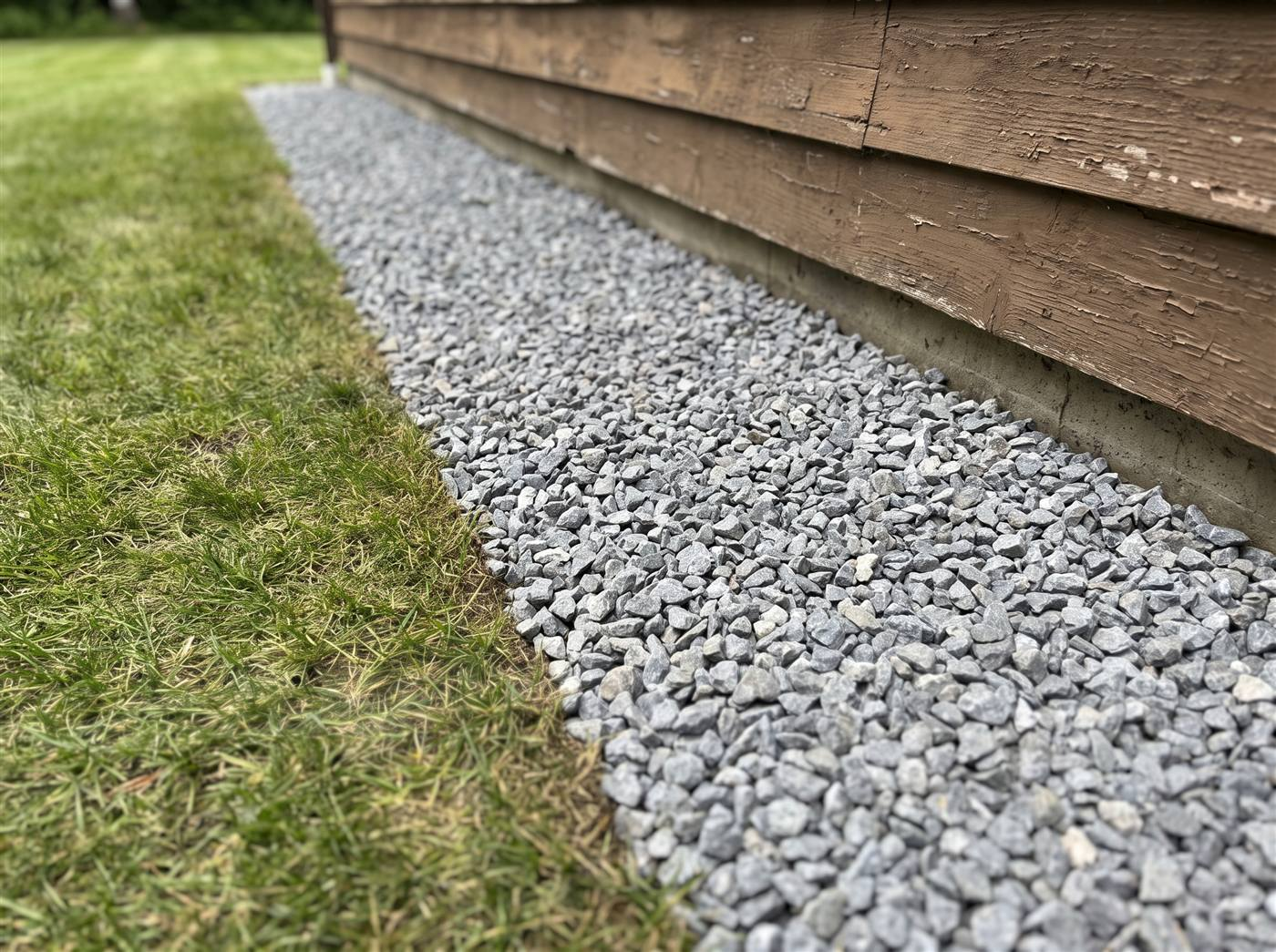
Local names for these products are all over the place and the gradings vary by quarry, so do not order by a name you read online. Ring the nearest quarry, tell them it is a residential driveway over whatever your subgrade is, and ask what they sell for base and what they sell for surface.
07Why Your Potholes Keep Coming Back
Because filling a pothole with stone does not fix what made the hole.
A pothole is a low spot that held water. The water softened what was underneath, traffic pumped the fines out, and the hole got deeper. Tip a bucket of fresh gravel in and you have put dry stone on top of a wet soft bottom. It will be a hole again by spring.
Doing it properly means digging the hole out until you are into firm material, squaring the sides rather than leaving a saucer, filling in layers with angular stone and compacting as you go, and leaving it slightly proud so traffic settles it flush. More work, lasts years instead of weeks.
But if potholes keep returning in the same places, stop patching. That spot is telling you water is sitting there, and the answer is upstream — crown, ditch or culvert — not more stone in the hole.
08What Your Excavator Is Actually Good At Here
Honest answer: it builds a driveway well and maintains one badly.
What it is genuinely good for: cutting and cleaning ditches, digging and setting the culvert, stripping topsoil and organic material off the route before you build, digging out soft spots and replacing them, cutting into a bank to widen, taking out stumps and roots along the line, and loading or moving material a bucket at a time.
What it is poor at: spreading stone evenly and holding a consistent crown over a long run. A bucket on a boom is a precise digging tool and a clumsy levelling one. Grading with an excavator is a real skill, and even done well it is slow over a few hundred feet.
If you already own a tractor, the box blade or rear blade on the back of it will keep a gravel driveway in shape far better and about ten times faster than the excavator will, and a tilted rear blade pulling material back toward the centre is the standard way to restore a crown. That is not a criticism of the excavator, it is the same division of labour we lay out in the comparison between these machines and the other ones people consider. Use the excavator to build it and fix the drainage. Use a blade to maintain it.
Routine maintenance grading runs somewhere around one to three times a year on a private drive, more if it carries real traffic. Do it when the surface is slightly damp — bone dry just moves dust around, and soaking wet makes ruts.
For setting the fall on a ditch or a culvert, a rotary laser takes the guesswork out, though a string line and a line level will do the same job for the price of a coffee and is what we would start with. If you are doing a lot of grade work it earns its keep, and renting one for a weekend is a reasonable middle path.
Self-levelling rotary laser level kit with tripod →
09Working Out How Much Stone
Arithmetic you do once, before you ring the quarry.
Length times width times depth, all in feet, gives cubic feet. Divide by twenty-seven for cubic yards. A four-inch layer is a third of a foot, so a hundred feet of twelve-foot driveway at four inches is 100 x 12 x 0.33, which is about 400 cubic feet, or roughly 15 cubic yards.
Two adjustments. Quarries usually sell by the ton rather than the yard, and the conversion depends on the material, so give them your cubic yards and let them convert it. And add some for compaction and for the stone that disappears into soft spots — the first load on a new driveway always goes further down than you expected.
Get the truck access sorted before the load arrives. A tandem dump truck needs somewhere to turn around, and a driver who cannot get in will tip it where it suits him, which leaves you moving fifteen yards of stone with a one-ton machine.
10The County Owns the End of Your Driveway
Where your driveway meets the public road is usually not your property, and that is where the culvert normally goes.
Most counties require an approach or entrance permit before you build or change a driveway connection to a public road, and many of them specify the culvert size, the pipe material, the width of the entrance and the sight lines. Some will set the pipe for you, or tell you exactly what to buy. Doing it without asking and getting it wrong can mean doing it twice.
One call to the county highway or road department settles it, and it is the same call that gets you free advice on sizing the pipe. Worth making before the stone is ordered, not after. The same goes for the other rules that catch property owners by surprise — it is cheaper to ask than to redo.
And before any of the digging: get the utilities located. Driveway work runs shallow and wide, which is exactly where buried services live, and a ditch line is a classic place to find a water service nobody remembered.
11What I Would Do
Spend the first day on water and the second day on stone. Not the other way round.
Walk it in heavy rain before you touch anything. That one walk tells you more than any amount of planning in the dry — you will see where water sits, where it crosses, where it runs down the middle instead of off the side, and where the edges are dammed up. Mark those spots.
Then fix them in order: open the edges, cut or clean the ditches, set or clear the culverts, then restore the crown, and only then order stone. Do that and a modest load of the right material will outlast three loads dumped on a flat wet driveway.
If the driveway is the reason you are buying a machine, it is a good reason — it is one of the jobs that pays for itself fastest, alongside the rest of the work waiting on an acreage. Just be realistic that you will want a blade of some kind for the upkeep, and think about what size machine the whole list calls for rather than this one job.