Mini Excavator Parts With No Brand Name: How to Find Them Anyway
Your machine is a pile of identifiable components wearing a paint job. Work down from the data plate to the measurements and you can order almost anything without knowing who built it.
01The Short Version
You are not going to find parts for your excavator. You are going to find parts for the pump, the engine, the cylinder or the final drive that happens to be bolted to it. That shift is the whole job.
Most imported mini excavators are assembled from components a factory bought in. The badge on the side is paint. The parts underneath are frequently standard items with their own manufacturers and their own numbers, and those numbers are findable even when the machine’s brand is not.
So the order of work goes: machine data plate, then engine plate, then the component itself, then measurements. Each step is a fallback for the one before. By the fourth you can order almost anything without ever knowing who built the machine.
And the single most useful thing you can do is the one that costs nothing and has to happen before the breakdown: photograph every plate on the machine while it is still clean and readable. Section 9.
02Start at the Data Plate
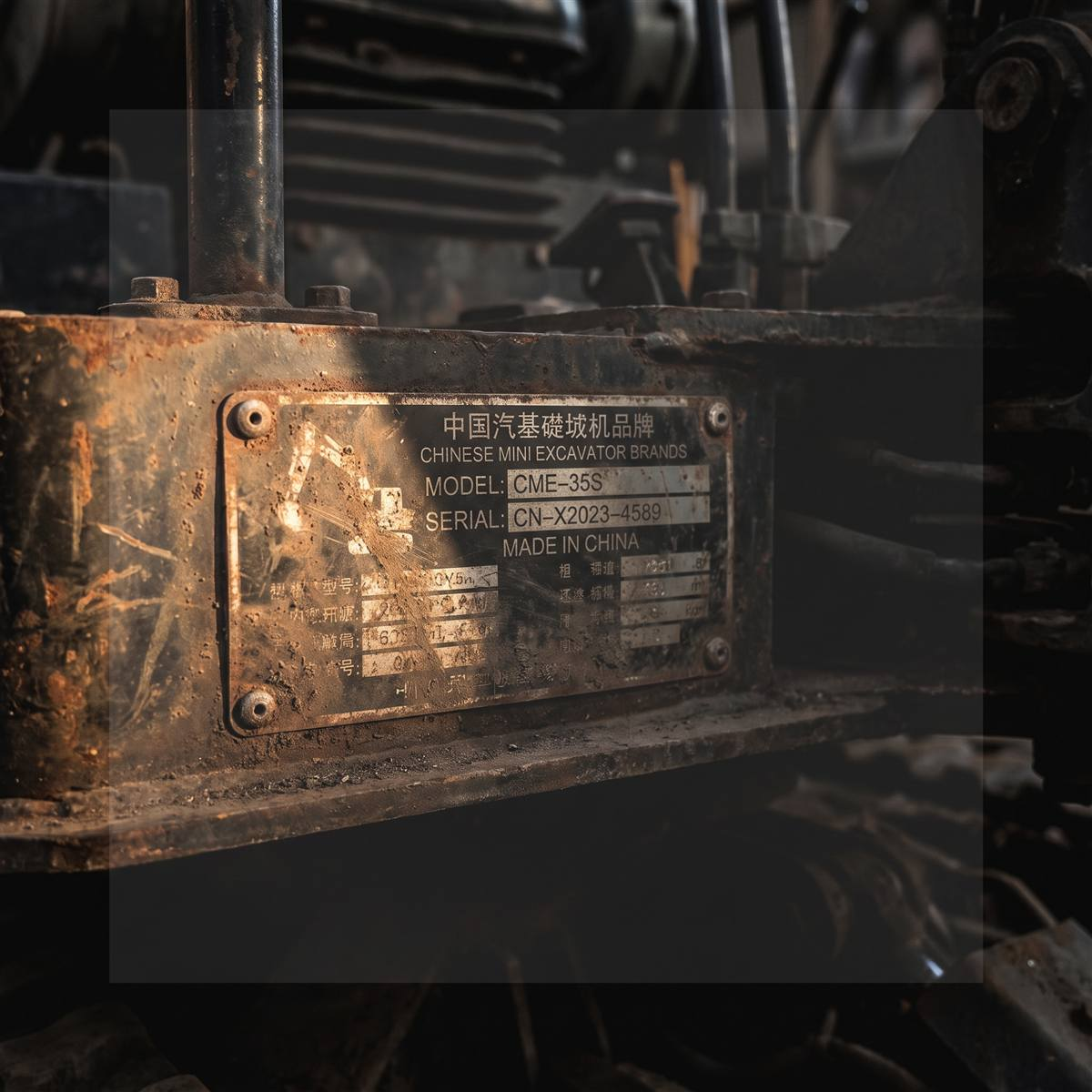
Even on a machine with no brand anybody recognises, the plate is rarely blank.
Look in the usual places: on the frame inside the cab door, on the main body near the swing bearing, under the seat, or on the boom foot. On these machines it is sometimes a riveted metal plate and sometimes a sticker that is already peeling.
What you are looking for and what each thing is worth:
Model number. Often something like a letter group and a number that encodes the weight class. Worth a web search on its own — a surprising number of these strings turn up on a factory’s own export listing, and that listing often names components.
Serial number. Matters less for ordering than people hope, because there is no dealer system to look it up in. It matters a great deal for proving the machine is yours and for what the machine is worth when you sell it.
Year and weight. The operating weight on the plate is worth more than the tonnage in the listing title, because the plate is a legal-ish document and the listing is marketing. If they disagree, believe the plate.
Manufacturer name, in small print. This is the prize. A good number of machines carry the actual factory name on the plate even when the badge on the side says something else entirely. Search it. The brand guide covers how much rebadging goes on and why the name on the boom tells you so little.
If the plate is unreadable, do not give up on it. Photograph it in raking light from the side rather than straight on, which picks up stamped characters a flat photo loses. A phone torch held at a shallow angle in a dark shed often reads a plate your eyes cannot.
03The Engine Has Its Own Identity
The easiest win on the machine, and the one most people skip.
The engine does not care what the excavator is called. It was built by Briggs and Stratton, or Kubota, or Loncin, or RATO, and it has its own plate or stamping with its own model and code. That makes the entire engine side of your parts problem a solved problem.
Filters, plugs, belts, gaskets, carburettor, coil, starter, fuel pump, injectors. All of it is ordered against the engine, not the machine.
On a Briggs the numbers are stamped on the blower housing or on a sticker on the shroud, and their own site will take that model and code and tell you what fits. Kubota engines carry a plate on the block. Loncin and RATO units have stamped numbers too, and while the support is thinner, the numbers still narrow a search dramatically.
Photograph the engine plate now. Right now, before you need it. It is behind a panel, it will be covered in oil and dust in two years, and it is the most useful photograph on the machine.
Worth knowing: if the machine was sold to you as having a particular engine and the plate says something different, that is not a parts problem, that is a listing honesty problem worth understanding before your next purchase.
04Look for the Component, Not the Excavator
This is the mental switch that makes everything else work.
Searching “parts for CME-35 mini excavator” gets you nothing, because nobody stocks parts for that. Searching for the number cast into the side of the hydraulic pump gets you a pump, because somebody makes a lot of those pumps for a lot of machines.
Nearly every major component has its own identity if you go and look:
The hydraulic pump usually has a cast or stamped model on the body. Gear pumps in particular are widely standardised and frequently cross-reference to common families.
The final drives and swing motor carry their own plates or castings. These are made by specialist firms and sold to many assemblers.
The control valve often has a casting number.
Cylinder seals are not ordered by brand at all. They are ordered by bore, rod diameter and seal type, which is pure measurement — section 5.
Tracks are ordered by three numbers: width, pitch and link count. Completely independent of who made the machine, and how to read a track size covers exactly that.
Pins and bushings are diameter and length. measuring them properly is the whole job.
Filters cross-reference by dimensions and thread even when the part number is meaningless — most filter suppliers publish a cross-reference by physical size.
Once you internalise this, the unbranded machine stops being frightening. It is a pile of identifiable components wearing a paint job.
05The Measurements That Replace a Part Number
When there is no number, the dimensions are the number. Get them right and you can order almost anything.
Measure in both inch and metric and write both down. These machines are built metric and sold into an inch market, and you will be talking to suppliers who work in either.
Pins: diameter and overall length, plus the width across the ears they sit in.
Bushings: inside diameter, outside diameter, length.
Cylinder seals: bore diameter, rod diameter, and the depth of the seal groove. Take the gland apart and measure the old seal if you possibly can.
Hoses: inside diameter, overall length, fitting type and thread at each end, and the pressure rating printed on the old hose. The thread is where people come unstuck — metric, JIC and BSP all look similar and none of them seal against each other.
Filters: outside diameter, height, thread size, and the gasket diameter.
A tape measure is not good enough for any of this. The difference between a 25 mm pin and a 1 inch pin is just over half a millimetre, and that is the difference between a part that fits and an expensive paperweight.
Check Price on a Digital Caliper →
It is the cheapest tool on the machine and the one that saves the most money. Get one that switches between inch, millimetre and fraction, because you will be doing exactly that conversion constantly. The full field method, including how not to get these numbers wrong, is in how to measure your machine properly.
06Photograph It Before It Comes Apart
Nobody does this and everybody wishes they had.
Before you undo anything, take more photos than feel necessary. The assembly from three angles. Each fitting before you crack it. The orientation of every hose. Any shims or spacers exactly where they sat.
Two reasons, and the second is the one people do not anticipate.
First, you have to put it back together, possibly in three weeks when the part finally arrives and you have forgotten which way round the spacer went.
Second, photographs are how you order parts from a supplier who has no idea what your machine is. A clear photo of a component next to a tape measure, sent to a hydraulics shop, gets a useful answer far more reliably than a paragraph of description. People who deal with this stuff daily recognise things by sight.
Keep them in one album on your phone. It becomes the thing you reach for every time.
07Where to Actually Buy the Part
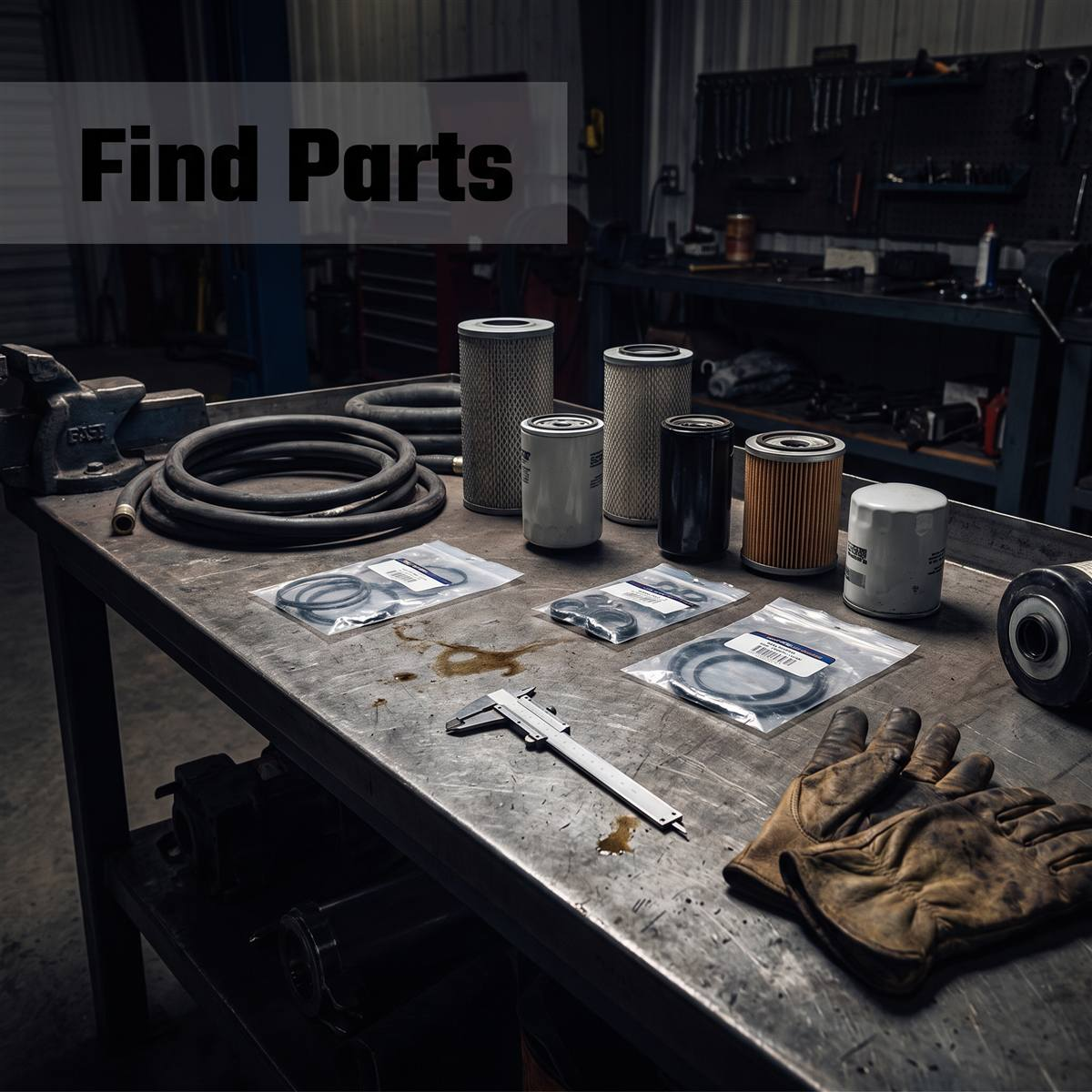
Roughly in the order worth trying.
1. The seller you bought it from. Worth one try. If they answer well, that is genuinely valuable and worth staying loyal to. If they go quiet, you have learned something important about the machine’s future and about what it is worth used.
2. The engine manufacturer’s network, for anything engine-side. This is why section 3 matters. A Briggs dealer does not care what the engine is bolted to.
3. A local hydraulics shop, for hoses, fittings, seals and cylinder work. This is the most underrated option on the list. They will make a hose to your old one while you wait and they do not need to know what machine it came off. Every rural area has one.
4. General equipment parts suppliers that cross-reference by dimension rather than by machine.
5. Amazon and the big marketplaces, for standardised wear items — tracks, pins, teeth, filters, couplers. Order by measurement, never by a listing that says it fits one-ton excavators, because that claim means nothing without the numbers behind it.
6. The original factory, direct. If section 2 gave you a real manufacturer name, a polite email with your model, serial and photos sometimes works remarkably well. Expect slow, expect shipping to hurt, but expect the right part.
08When Nothing Matches
It happens. Here is the order to work through before you give up on a machine.
Can it be repaired rather than replaced? Cylinders get resealed. Hoses get remade. Pumps get rebuilt. A hydraulics shop repairs things that nobody sells any more, and that is most of what they do.
Can a standard part be adapted? A different pin with a machined spacer. A hose with a different fitting and an adapter. This is normal practice in the trade, not a bodge, as long as the pressure and load ratings are respected.
Can it be made? A machine shop will turn a pin or a bushing from your old one or your drawing. For a one-off wear part this is frequently cheaper than importing.
Is there a donor machine? A broken example of the same import sold for parts is worth watching for.
What not to do: weld a structural part back together and carry on lifting with it, or substitute a fastener or a hose with a lower rating than the one that failed. The things that actually hurt people includes exactly that kind of improvisation.
09Build the File Before You Need It
Twenty minutes, once, on a dry afternoon. It is the difference between a two-day outage and a two-week one.
Walk the machine with your phone and photograph, clearly and in good light:
The machine data plate. The engine plate. Any casting numbers on the pump, the control valve, the final drives and the swing motor. The track sidewall where the size is moulded in. The filter part numbers before the labels come off. Any sticker in the cab with a hydraulic or electrical diagram.
Then measure and write down, in both units: track width, pitch and link count. Bucket pin diameter and the width between the ears. Bucket width. Cylinder rod diameters.
Put all of it in one album or one folder, and keep a copy somewhere that is not your phone.
The day something breaks, you will not be lying under a machine in the rain trying to photograph an oily plate with one hand. You will already have the numbers, and you will be ordering while everybody else is still identifying. It also happens to be most of the record keeping the maintenance schedule asks for anyway.
10Questions People Ask
The ones that come up the first time something fails.
My machine has no plate at all. Now what? Go straight to section 4 and work component by component. Plenty of people run machines for years without ever establishing who built them. It is inconvenient, not fatal.
Can I use the serial number to look up parts? Generally no, because there is no dealer parts system behind it. It is for ownership and resale, not ordering. That surprises people coming from name-brand equipment.
Are parts from a different Chinese brand interchangeable? Often, genuinely — many machines share component suppliers. But interchangeable by measurement, never by assumption. Check the numbers every time.
Is it worth buying a spare set of anything up front? Filters and a cylinder seal kit, yes, if you can identify them while the machine is new and clean. Those are the two that stop the machine and take longest to source.
How do I know a replacement part is rated properly? For hoses and rigging, the rating is printed or stamped on it. If a part has no marking and no spec sheet, treat the rating as unknown rather than adequate.
Does this affect what I should buy next time? Yes, and it is the most useful thing on this page. Ask the seller to quote you a track, a swing motor and a boom cylinder seal kit before you buy. A real parts operation answers in a day.
11Bottom Line
The brand on the side is the least useful thing about the machine. Stop looking for it.
Work down the ladder: machine plate, engine plate, component castings, measurements. One of those four will get you the part, and the fourth one always works because a dimension is a dimension whoever made it.
Get a caliper, photograph the plates while they are readable, and build the file on a dry day rather than a bad one. That turns an unidentifiable machine into an ordinary one.
And when you are buying your next machine, the parts question is the tiebreaker that matters more than any spec: which companies actually stand behind what they sell.