Mini Excavator Controls Explained: Pilot, Mechanical, and Why Yours Feels Jerky
Two joysticks, four functions, and a control pattern the listing almost never mentions. What you have, how to find out, and why jerky controls are nearly always the oil rather than the levers.
01The Short Version
Two things decide how a mini excavator feels to operate: what kind of controls it has, and which pattern they are wired in. Most listings tell you neither.
Pilot controls use oil to do the work, so the levers are light and move proportionally with your hand. Mechanical controls are a rod and linkage shoving the valve spool directly, so they are heavier and more abrupt. Most cheap imports are mechanical. Some of the better ones are pilot, and it is worth asking before you buy.
The pattern is which joystick does what. There are two, and here is the thing nobody says out loud: the names for them are used inconsistently all over the internet, including by people who should know better. Do not trust a label. Test your own machine, which takes ten seconds and is in section 4.
And if your controls feel jerky, it is usually not the controls. It is cold oil, air in the system, or a technique problem, in roughly that order. Section 5.
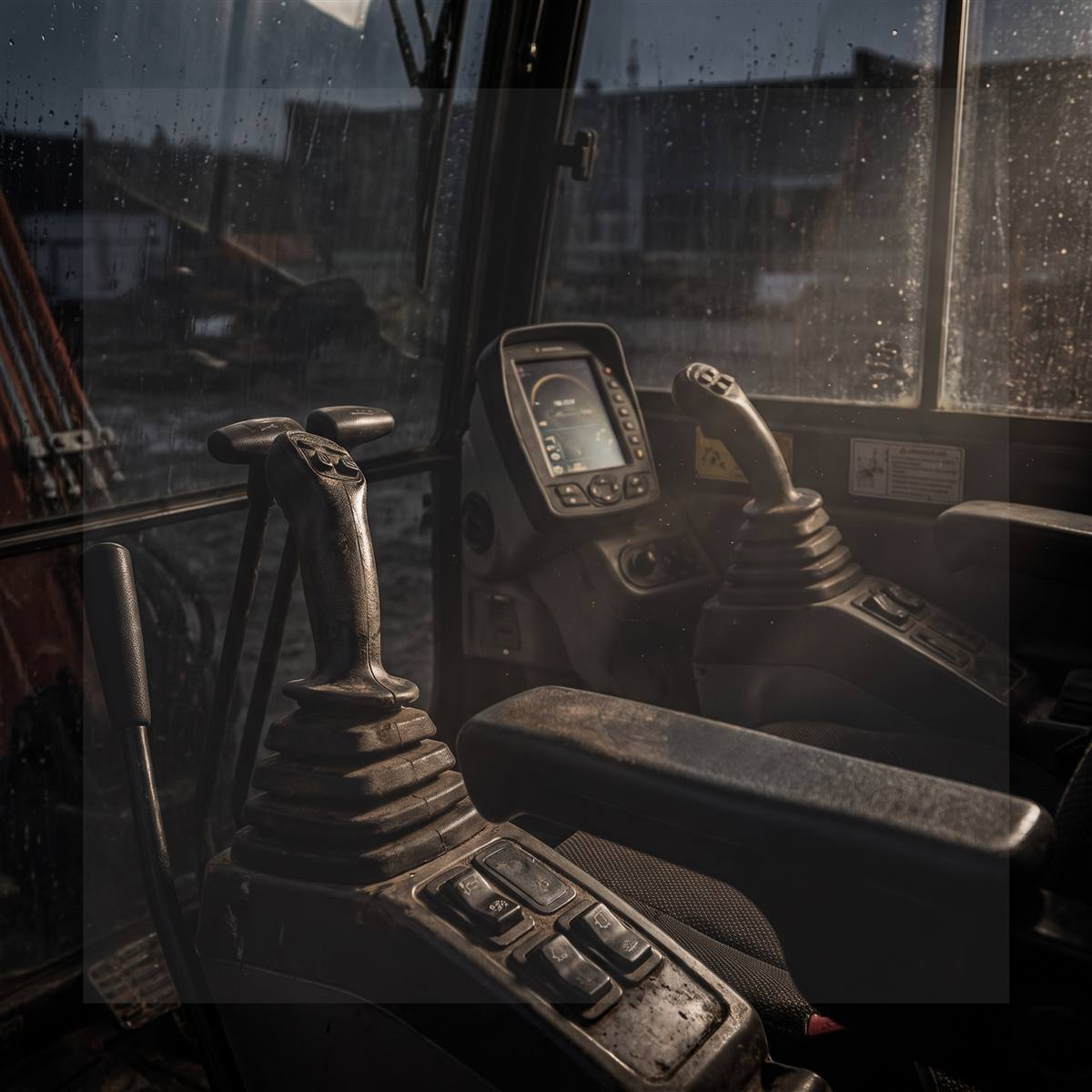
02Pilot Controls vs Mechanical Controls
This is the single biggest difference in how two machines feel, and it is almost never in the spec list.
Mechanical, or direct, controls. The joystick is connected by rods and linkages straight to the spool in the main control valve. You move the lever, the linkage moves the spool, oil goes where you sent it. It is simple, it is cheap, and there is very little to go wrong that you cannot see.
What it costs you is feel. You are physically pushing against spool springs and oil pressure, so the effort is higher, and the first part of the lever travel often does nothing at all before the spool cracks open and the function suddenly starts. That dead band is what makes a mechanical machine feel notchy to somebody used to better.
Pilot controls. The joystick operates a small, low-pressure valve. That sends a bit of oil down a pilot line to one end of the main spool, and the oil pushes the spool over. Your hand is moving a cup of oil, not a valve.
The result is a light lever, far better proportional control, and the ability to run two or three functions at once without fighting the machine. It is the reason an operator can step off a name-brand machine onto a cheap one and immediately say it feels agricultural.
What it costs you is complexity. More hoses, a pilot pressure supply, and joysticks that can wear and get sloppy on their own. On an import, pilot controls are also one more system you need parts for.
How to tell which you have, if nobody will say. Shut the machine down, let the pressure off, and move a joystick with your hand. A mechanical lever has weight and a mechanical feel, and you can often hear the linkage. A pilot joystick with the machine off is usually light and loose, because there is nothing behind it. Then look at the base of the joystick. Rods and linkage going down into the floor means mechanical. Four small hoses means pilot.
Which should you buy? If you have the choice and the budget, pilot, every time. If you are in the 1 ton class, you will mostly get mechanical and it is not a dealbreaker — the machines worth looking at include both, and the better-specified ones say so in the listing.
03The Two Patterns, and Why the Names Are a Mess
There are two standard layouts. Which name belongs to which layout is where it falls apart.
Both patterns put swing on the left joystick, left and right. Both put the bucket on the right joystick, left and right. Those two never move. What swaps between the patterns is the boom and the arm — which one is on the left stick fore-and-aft, and which is on the right.
So the whole argument comes down to one question: when you pull the left stick back, does the arm come in, or does the boom come up?
The two layouts are usually called ISO and SAE, and the standards normally cited are ISO 10968 and SAE J1177. You will also hear them called excavator pattern and backhoe pattern, or Japanese and American, or Cat and Deere.
Here is the part that matters. Go looking for which name goes with which layout and you will find reputable-looking sources that flatly contradict each other, including pages that have the two reversed from one another while both sounding completely sure. We checked, and it is genuinely inconsistent in the wild.
The practical consequence: never take a seller’s word for the pattern, and never assume the machine you are climbing into matches the last one you ran. Rental yards switch them. Previous owners switch them. Imports arrive in whatever the factory felt like that day.
Which is why the only answer that is always right is to find out for yourself, before the bucket is in the air.
04How to Find Out Which Pattern Yours Is In
Ten seconds, done from the seat, before you do anything else. Do this on every machine you have not personally run that week.
First, make the area safe. Nobody within the swing radius, bucket low and empty, machine on level ground, blade down, and plenty of clear space in front of you. If you are not sure what the swing radius is, the safety guide covers why that circle is the thing that kills people.
Then, with the engine running at idle:
1. Pull the left joystick straight back, a small amount. Watch what moves. If the arm curls in toward you, you are in one pattern. If the boom lifts, you are in the other. That single test tells you everything, because the rest follows from it.
2. Push the left joystick left and right. The house should swing. If something else happens, stop — the machine is wired oddly and you need to work the whole thing out before you use it.
3. Confirm the right joystick. Left and right should curl and dump the bucket. Fore and aft will be whichever of boom or arm was not on the left stick.
Say the result out loud or write it on a bit of tape on the dash. “Left back equals arm in.” That is your pattern, in the only language that matters.
The reason to be fussy about this is not pride. The dangerous moment is not the first minute, when you are concentrating. It is twenty minutes later when you react without thinking, and the machine does the opposite of what your hands intended with a loaded bucket in the air.
05Why Your Controls Feel Jerky
This is the most common complaint about a cheap machine, and the control levers are usually innocent.
Run through these roughly in order of likelihood.
Cold hydraulic oil. Far and away the most common. Cold oil is thick, it will not move through the valve smoothly, and everything either does not move or moves all at once. A machine that is jerky for the first ten minutes on a cold morning and fine afterwards does not have a control problem. It has a warm-up problem. Idle it, then work it gently through full travel on every function for a few minutes before you ask it for anything real.
The wrong grade of oil in it. Related, and common on imports that got filled with whatever was cheap. Grade matters more in cold climates than people think.
Air in the system. Air compresses, oil does not. A function that bounces, judders or feels spongy, particularly after a hose has been off or the tank has run low, is air. It often works itself out after cycling everything slowly through its full range a dozen times.
Low oil. Check it properly, on level ground, with the machine in the position the manual asks for. A pump that is occasionally getting a gulp of air gives you exactly the symptoms above.
Mechanical linkage binding. On a direct-control machine, the rods and pivots under the floor can be dry, bent, or packed with mud. That gives you a lever that sticks and then lets go, which feels exactly like a hydraulic problem and is not.
A sticking spool. Contamination in the oil can make a spool hang up rather than return smoothly. This one is a real problem, and it is the one that argues for changing the hydraulic filter on the schedule instead of when you remember.
It is you. Said kindly, because it is true for everybody at the start. A mechanical machine with a dead band punishes stabbing at the lever. Section 8.
If the machine is also weak or fading as it warms up, that is a different conversation and the hydraulic problems guide runs through the symptoms properly.
06The Ones You Can Actually Fix Yourself
Three of the causes above are a Saturday morning. The rest are somebody else’s problem.
Warm it up properly. Free. Fixes more jerky controls than any part you can buy.
Get the oil right. If the machine came with unknown oil in it, or it has done a season and nobody knows when it was last changed, fresh oil and a new filter is the single most useful thing you can do to how the machine feels. AW 32 is the common grade for these small machines in most climates.
Check Price on AW 32 Hydraulic Oil →
Check the grade against your own manual before you pour anything in. AW 32 and AW 46 are not interchangeable everywhere — the heavier grade suits hot climates and hard continuous work, the lighter one suits cold. If your machine calls for something specific, it wins over anything written here. And the general case for staying on a fluid schedule rather than a feeling applies to a cheap machine more than an expensive one, not less.
Clean and grease the linkage. On a mechanical machine, get under there with a wire brush and a grease gun and work every pivot. Costs nothing and sometimes transforms it.
Cycle the air out. Slow, full-travel movements on every function, repeatedly, with the machine warm.
What is not a driveway job: a sticking spool in the main valve, a worn pilot joystick, or anything that needs the valve body apart. You can diagnose it, and diagnosing it properly means reading actual pressures rather than guessing.
Check Price on a Hydraulic Pressure Test Kit →
That is a real tool at a real price and most owners do not need one. If you have more than one machine, or you are the person your neighbours call, it pays for itself the first time it stops you buying a pump you did not need. What the parts actually cost puts that in perspective.
07The Pattern Change Valve
Some machines can be switched from one pattern to the other. Whether you should is a separate question.
A selector valve re-routes the pilot or control lines so the boom and arm swap sticks. On machines that have one it usually lives under the seat or behind an access panel, sometimes with a little window showing which position it is in. Plenty of cheap imports do not have one at all.
If you have one, there are two sensible reasons to use it. One, you learned on a particular pattern somewhere else and your hands already know it. Two, somebody else runs the machine regularly and they are fluent in the other one.
There is one bad reason: switching back and forth. Pick a pattern and stay there. The muscle memory is the whole point of having one, and a person who switches every few weeks ends up fluent in neither and reaching for the wrong stick at the wrong time.
If you do change it, re-run the ten-second test from section 4 afterwards and put fresh tape on the dash. And if the machine is going to a rental customer or a neighbour, tell them, out loud, which way it is set.
08Feathering: What Makes a Cheap Machine Feel Expensive
The single biggest improvement available to most owners costs nothing and takes about a weekend to start sinking in.
New operators move a joystick like a light switch: off, then on, then off. On a machine with mechanical controls and a dead band, that gives you nothing, nothing, nothing, then everything. The machine lurches, the load swings, and it feels like a badly built machine. Often it is a badly driven one.
Feathering is moving the lever to the edge of where the function starts and living there. Small, continuous corrections rather than big commands. Once you can find that point without looking, a cheap machine gets dramatically smoother.
Three habits that get you there faster:
Rest your wrist. Brace your forearm on the armrest and move the stick with your fingers, not your whole arm. You cannot make fine inputs with an unsupported arm, and you will be worn out by lunchtime.
Run two functions at once on purpose. Lowering the boom while curling the bucket is what makes a flat trench bottom. Practise it on a spoil pile where it does not matter.
Idle down to learn. Lower engine revs means less oil flow means everything happens slower and you get more time inside each movement. Once it is smooth at low revs, bring the revs up.
Nearly everybody who complains their imported machine is unusable in the first week is fine by the end of the month. Give it the month before you decide what you bought.
09Questions People Ask
The ones that come up in the first few hours.
Are pilot controls worth paying more for? If you will spend real hours in the seat, yes, clearly. If the machine does ten hours a year, it is a nice-to-have and the money is better spent on an attachment you will actually use.
Why do my controls work fine, then go sluggish after an hour? That is heat, not controls. Hydraulic oil getting too hot thins out and the machine goes soft. Why it happens and how to stop it is the right page for that.
Can I change my machine from mechanical to pilot controls? Not realistically. You would be adding a pilot pressure supply, new joysticks, new lines and a different valve. Buy the machine you want.
My left stick does the travel too. Is that normal? No — travel is normally on two separate foot pedals or hand levers at the front, not on the joysticks. If one joystick is driving a track, stop and work out what is going on before you use it.
Does the engine affect how the controls feel? Indirectly. Everything you feel comes from the pump, and the pump is turned by the engine, so an engine that bogs under load makes the hydraulics feel weak at exactly the wrong moment. That is one of the quiet arguments in the gas versus diesel decision.
Is there a standard I can just look up? ISO 10968 and SAE J1177 are the standards usually cited for operator controls. Knowing the numbers will not tell you how your particular machine arrived from the factory, which is why section 4 exists.
10Bottom Line
Test the pattern, warm the oil, and stop stabbing at the levers.
Pilot controls feel better than mechanical and cost more. At the small end you will mostly get mechanical, and that is survivable — plenty of good work gets done with it every day.
The pattern is the part worth being disciplined about, because the names are unreliable and the machine does not care what you assumed. Ten seconds in the seat settles it.
And when the controls feel bad, look at the oil before you look at the levers. Cold, wrong, low or dirty oil accounts for most of it, and all four are cheaper to fix than anything you were worrying about. If you want the whole picture of what is behind those joysticks, how the hydraulic system actually works is the next thing to read.
Knowing the pattern is step one. What to do with it is step two — how to actually dig with the thing, and why your first bucket comes up empty picks up where this page stops.