Gas vs Diesel Mini Excavator: Which One Should You Actually Buy?
Most comparisons treat this as an even choice between two engines. Go and look at what is actually for sale in your size and it usually is not — and the thing that should worry you is not the fuel at all.
Whichever fuel you end up with, it wants handling differently before the machine sits for a season — gas and diesel want opposite things over winter.
01The Short Version
For most people reading this, the honest answer is that you will not actually get to choose. The size you need picks the fuel for you.
Under about 1.2 ton, nearly everything you can buy is gas. Briggs and Stratton, Loncin, RATO. Diesel starts showing up around 1.3 ton and takes over above two. So if your gate is 36 inches wide and your truck tows 3,500 lbs, you are buying a gas machine whether you like the idea or not.
Where you do have a choice, the rule is dull but it holds. Gas if you will run it a few weekends a year. Diesel if it is going to work.
Gas is cheaper to buy, lighter, simpler to fix, and perfectly happy doing the kind of work most acreage owners actually do. Diesel pulls harder down low, burns less fuel, lasts longer, and costs more in every direction including the repairs.
The one thing that should genuinely worry you is not the fuel at all. It is a listing claiming a Kubota diesel that no Kubota dealer has ever heard of. Section 5 is about that, and it is the part of this page worth reading even if you have already made up your mind.
02The Part Nobody Tells You: Size Picks the Fuel
Every other article treats this like an open choice between two equal options. Go and look at what is actually for sale and it is not.
Walk the listings in the size most homeowners end up in and the pattern is immediate. The 1 ton machines are gas. Nearly all of them. The engine is a 420cc or thereabouts single-cylinder, and it is either a genuine Briggs and Stratton or a Chinese equivalent like a Loncin or a RATO.
Move up to 1.3 ton and diesel appears. Move up to 2 ton and diesel is the default.
There is a straightforward reason. A diesel of the same power is heavier and costs more to build. On a machine that only weighs a ton to begin with, that is a big chunk of your weight budget and a big chunk of your price. The economics only start working once the machine is big enough to carry the engine without the whole thing getting silly.
So the decision tree runs in an order most people have backwards. Work out what size machine your gate and your trailer actually allow first. That usually leaves you with one fuel. Only if you land right on the line around 1.3 ton do you have a genuine choice to make, and then the rest of this page matters.
If you are already down at the small end, the honest news is good: gas at that size is not a compromise anybody forced on you, it is simply what the class is.
03What a Gas Engine Actually Gets You
The case for gas is better than its reputation, and most of it comes down to the day something breaks.
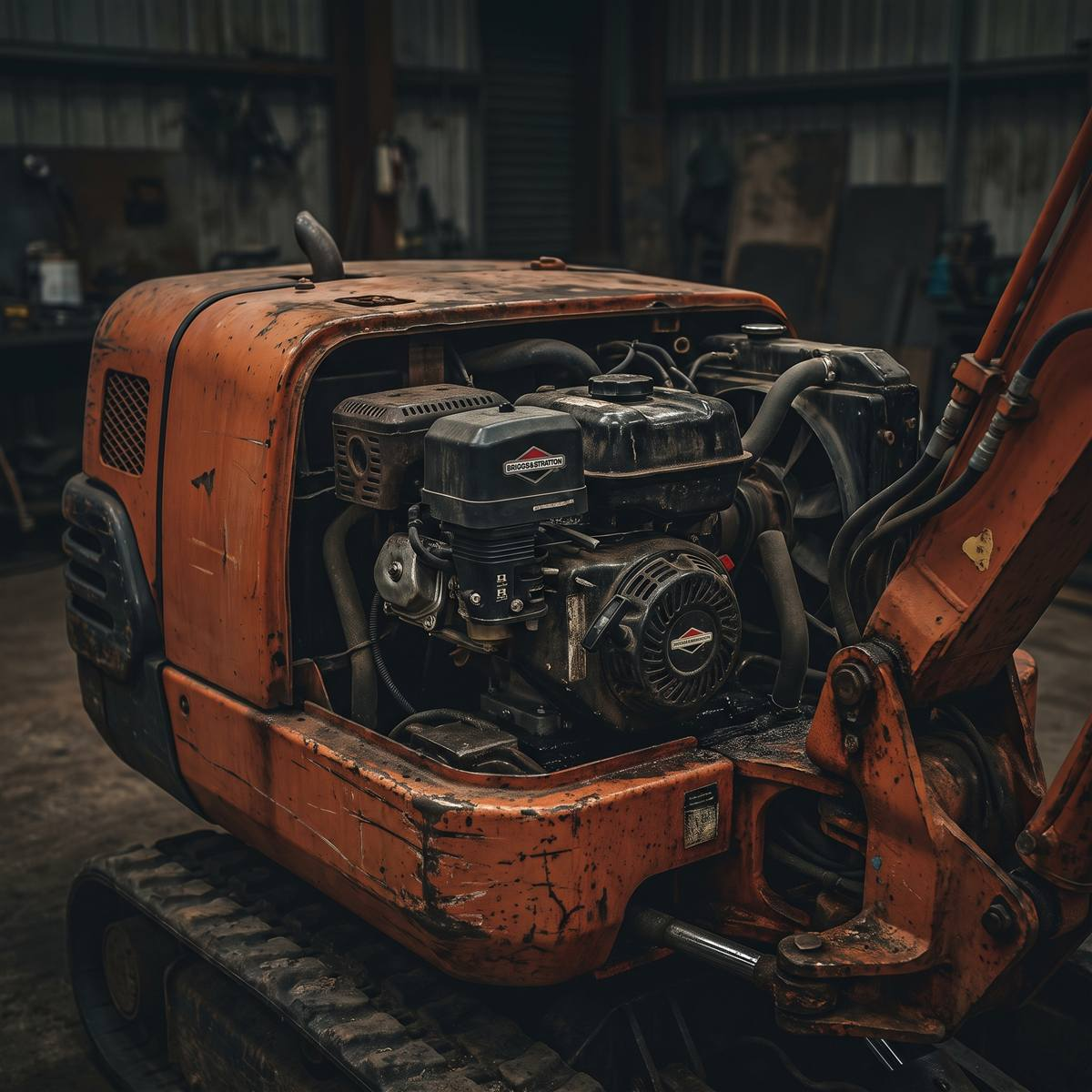
You can get parts anywhere. This is the big one. A Briggs and Stratton single-cylinder is the same family of engine that has been in mowers and pressure washers and generators for decades. Plugs, filters, carburettors, coils, pull cords. The small-engine shop in town has them, and so does the farm store. Compare that to waiting on a part for an obscure imported diesel.
You can work on it yourself. A carburettor and a spark plug are things a reasonably handy person can sort out in an afternoon with a YouTube video. A diesel injection system is not. If the honest reason you are buying an import is that you would rather fix it than pay somebody, gas is on your side.
It is lighter. Which matters more than people expect, because weight is what decides whether your trailer is legal and whether the machine sinks into wet ground.
It costs less up front. Across the machines we track, the gas 1 ton class runs in the high four thousands while the diesel machines start a good bit above that. Prices move, so treat that as a shape rather than a quote.
It starts in the cold without drama. No glow plugs, no waiting, no gelled fuel. On a January morning a gas engine just goes.
The honest downsides: it drinks more fuel, it makes its power higher up the rev range so it feels busier under load, it will not last as many hours, and it puts out considerably more carbon monoxide — which matters if you have an enclosed cab, and the safety guide covers exactly where that catches people.
And one practical thing that kills more small gas engines than hard work ever does: fuel sitting in it. Pump gas with ethanol in it absorbs water and goes off. Leave it in a carburettor over a winter and you will spend the spring cleaning jets. A few dollars of stabiliser in the can is the cheapest insurance on this whole page.
Check Price on Fuel Stabiliser →
Put it in the can, not just the machine, so every drop you pour is already treated.
04What a Diesel Actually Gets You
Diesel is the right answer for a narrower set of people than the internet suggests, but for those people it is clearly right.
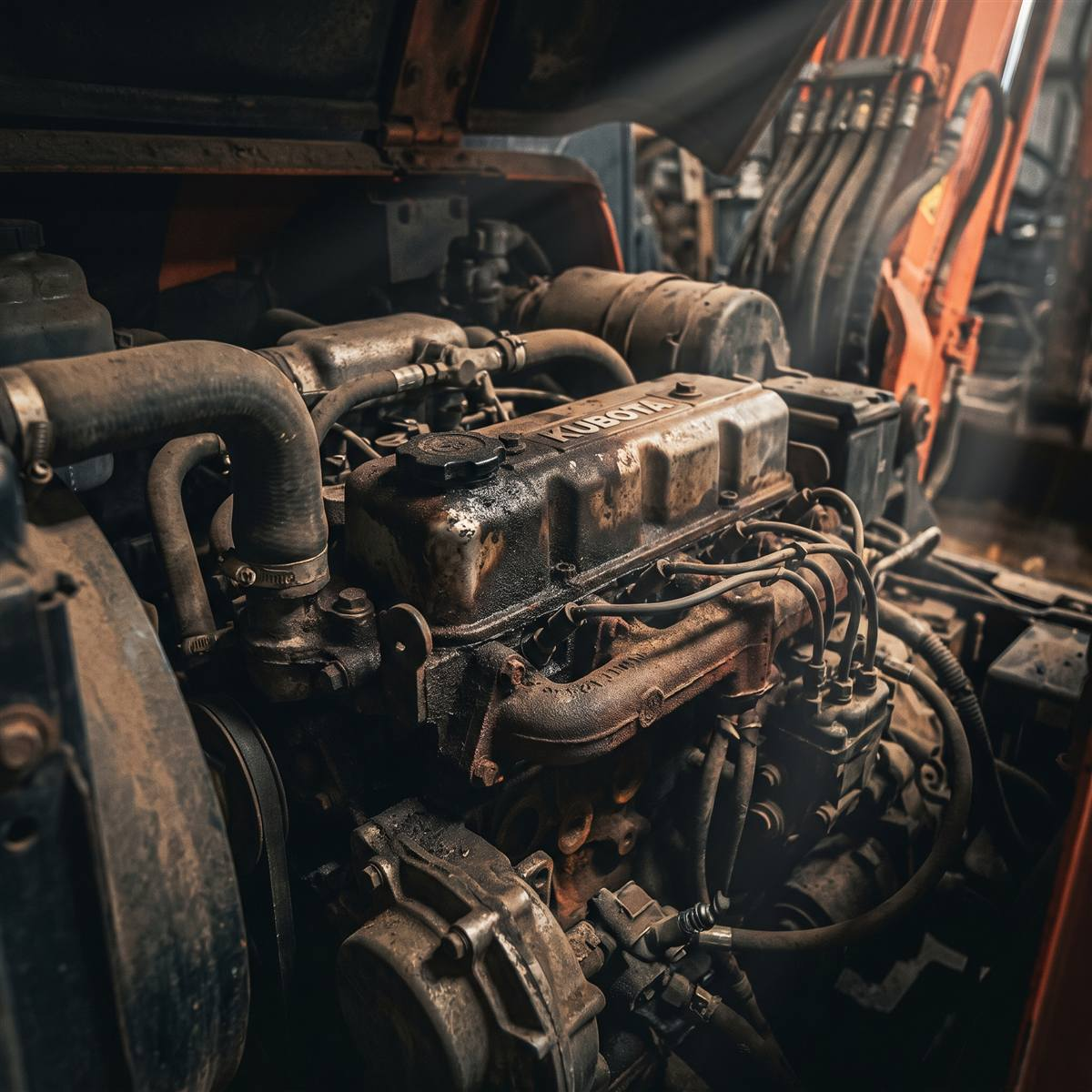
Torque low down, which is what digging is. Digging is not a high-speed job. It is leaning on something until it gives. A diesel makes its pull at low revs, so it does that without screaming and without bogging the hydraulics when you load it up hard.
It burns less fuel. Meaningfully less, for the same work. On a weekend that is pocket change. Over a few hundred hours it adds up, and the running cost breakdown puts real numbers around it.
It lasts. Diesels run at lower revs under heavier loads and are built accordingly. If you plan to put real hours on the machine, this is the argument that matters most.
The weight is partly a feature. A heavier machine is a more stable machine. The same engine mass that hurts you on the trailer helps you every time you reach out to lift something.
The downsides are real too. It costs more to buy. It is heavier, which may put you over your trailer rating. Repairs are specialist work — injection problems are not a driveway job. And in genuine cold it needs looking after: glow plugs that work, and fuel that has not turned to wax.
That last one is worth a bottle in the toolbox if you are anywhere that sees a hard freeze. Untreated diesel starts dropping wax crystals as it gets cold, they block the filter, and the machine simply stops.
Check Price on Diesel Anti-Gel →
You only need it in the cold months, and you need it before the cold snap, not after the filter has already waxed up.
05The “Kubota Diesel” That Cannot Exist
If you read one section on this page, make it this one. It has nothing to do with which fuel you prefer and everything to do with not getting taken.
Plenty of imported machines advertise a Kubota diesel, because Kubota is the name that makes a buyer relax. Some of them genuinely have one. The MachPro runs a Kubota Z482 and the TYPHON runs a Kubota D902, and both of those are real engines you can look up.
Others describe something that does not exist.
The tell is a listing advertising a single-cylinder, air-cooled Kubota diesel. Go and look at Kubota’s own industrial engine range and count the cylinders yourself. Their diesels are multi-cylinder and water-cooled. A single-cylinder air-cooled Kubota diesel is not a rare variant or an export model. It is a description somebody wrote to make a cheap engine sound expensive.
And here is why it matters beyond the engine. If a seller will write that about the single most checkable spec on the machine — the one you can verify in thirty seconds on the manufacturer’s own website — then ask yourself what else on that listing got the same treatment. The tonnage. The digging depth. The warranty. We walked through one listing where exactly that happened.
Same discipline on the gas side, incidentally. “Briggs and Stratton” should mean a genuine Briggs engine you can find in their own catalogue, not “Briggs-style” or “B and S type”. Those two extra words are doing a lot of work.
The fix is dull and it works: ask the seller for a photo of the engine data plate before you buy. A real engine has one. The brand comparison goes through which companies answer that question and which go quiet.
06Cold Mornings and Hot Afternoons
The two fuels fail in opposite weather, and most people only find out in the month it happens.
Cold is the gas engine’s afternoon. No glow plugs to wait on, no fuel to gel. Choke it, pull it or turn the key, and it runs. If you are the sort who goes out on a frozen morning to move snow or fix a water line, that is a genuine advantage and nobody mentions it.
Cold is where diesel asks for attention. Glow plugs have to actually work, the battery has to be healthy because the engine is harder to turn over, and the fuel needs treating before the cold arrives. None of that is difficult. All of it is the sort of thing that gets skipped until the machine will not start, and then it looks like the machine is junk when really it was the fuel. What is actually going on when it will not turn over separates the two.
Heat is the other way round. These small machines are cooled to a price either way, and a gas engine working hard in July on a dusty site is the one more likely to get unhappy, partly because the radiator or oil cooler is smaller and the airflow is worse. If the machine starts fading as it warms, that is nearly always cooling or hydraulic oil temperature rather than the fuel in it, and overheating has its own set of causes worth knowing.
07What Each One Costs You to Keep Running
Buy price is the number people compare. It is not the number that decides this.
Fuel. Diesel wins, and it is not close over a long job. For a few weekends a year the difference is lost in the noise.
Routine service. Roughly a wash. Both want oil, both want filters, both want the air filter kept clean, and on these machines the hydraulic side costs you more than the engine side either way.
The repair that hurts. This is where it separates. A gas engine’s worst common day is a carburettor or a coil, and both are cheap parts you can fit yourself. A diesel’s worst common day is the injection system, and that is a bill plus somebody else’s shop.
Parts availability. Gas wins decisively, and not by a little. A Briggs is a Briggs. An unbadged imported diesel may have no parts network at all on this continent, which is the exact problem the parts guide exists to get you out of.
So the pattern is: diesel costs less per hour to feed, more per incident to fix, and demands more from your ability to find parts. Gas costs more per hour to feed and far less per incident to deal with.
If you are running a hundred hours a year on an import with a thin parts supply, that maths is closer than the fuel-economy argument alone suggests.
08What Happens When You Sell It
Worth a minute, because nobody buys their last machine first.
Diesel holds value better. That is true across used equipment generally, and the reason is simple enough: the next buyer is thinking about hours, and a diesel with hours on it is a more believable prospect than a gas engine with the same hours.
But the brand matters more than the fuel when the machine is an import. A recognised machine with a real engine in it and a parts supply behind it sells. An unbadged machine with a mystery engine sits, whatever it burns. What a buyer is nervous about is the same thing you were nervous about.
Keep the paperwork, keep the hours honest, and keep the engine data plate clean and readable. That plate is what turns “it has a Briggs” into something the next person can verify.
09So Which One Should You Buy?
Here is how it actually falls out.
Buy gas if: you need a machine under about 1.2 ton, you are towing with a half-ton truck and a light trailer, you expect to use it in bursts rather than steadily, you would rather fix it yourself than book it in, or the budget is the thing setting the limit. That is most people reading this, and it is not a consolation prize.
Buy diesel if: you are already at 1.3 ton or above for other reasons, you expect to put real hours on it year after year, you do a lot of heavy lifting where the extra machine weight helps, or you are running a side business with it where fuel burn and resale both show up on paper.
Buy neither yet if you cannot answer how many hours a year you will genuinely use it. That is the honest crossover question and the buy-versus-rent maths answers it better than any engine comparison can.
What I would do, if it were my place and my money: at 1 ton, buy the gas machine and put the difference toward a thumb and a decent set of tracks. At 2 ton, buy the diesel and stop thinking about it. At 1.3 ton, where you genuinely get to choose, I would take the diesel if it carries a real engine I can verify, and the gas machine if the diesel on offer is a mystery with a Kubota sticker on it. A known gas engine beats an unknown diesel every time.
10Questions People Ask
The ones that come up once somebody has narrowed it down to two machines.
Is a gas mini excavator any good, honestly? Yes, for what most acreage owners do with one. The gas machines in the 1 ton class dig footings, run trenches, set posts, move dirt and pull small stumps perfectly well. What they are not is a machine for eight-hour days, week after week.
Do gas mini excavators have less digging power? Not in the way people mean. Digging force comes from the hydraulics, not directly from the fuel. What the engine decides is whether the pump can keep up when you load everything at once. That is why a gas machine can feel strong on a single function and busy when you ask for three at the same time, and breakout force explains what the number on the listing is really measuring.
Can I convert a gas machine to diesel later? No, not sensibly. You would be changing the engine, the mounts, the cooling, the wiring and the weight distribution on a machine designed around the original. Buy the fuel you want.
Does the EPA care which one I buy? Both need to be properly certified to be sold here, and the label is what proves it. That is the same check either way and the EPA and legal guide shows what the label should say.
Is a Loncin or RATO engine as good as a Briggs? They are not the same thing and the listings sometimes blur it. They are generally serviceable engines. The difference that matters to you is not quality on day one, it is whether you can buy a coil for it in four years. On that, Briggs is clearly ahead.
Which is quieter? Gas, usually, at idle. Under load there is less in it than you would think, and both are loud enough that you should be wearing hearing protection.
11Bottom Line
Size first, fuel second, engine brand third — and the third one is where people actually get hurt.
If the machine you need is under 1.2 ton, you are buying gas, and that is fine. If it is 2 ton, you are buying diesel, and that is fine too. The band in between is the only place this is a real decision, and there the tiebreaker is not the fuel at all. It is whether you can name the engine and find a parts list for it.
A known gas engine beats an unknown diesel. Every time, without exception. Everything else on this page is detail hanging off that one sentence.
When you are ready to compare actual machines, the picks worth considering are set out here with what each one runs.